Sonia had rented a car and we were off to the Sanxia District fairly early in the morning, around 10 a.m. Blasting tunes from Gaurang’s phone, the highway breeze coming through the windows, our art trip had finally come to fruition. We were planning to do a day of crafts for about a month, and even though we had to reschedule it before, today was the day.
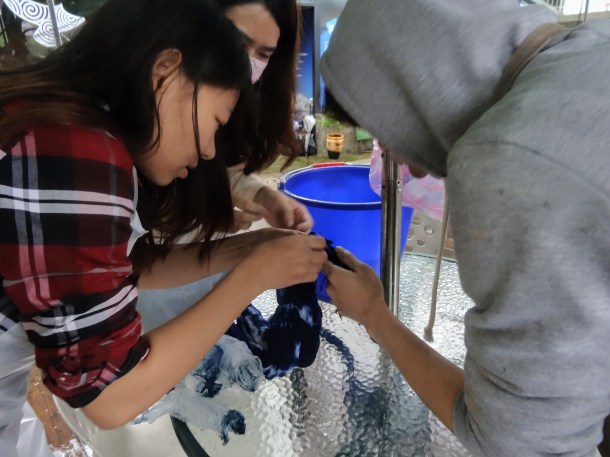
It was a little difficult to find parking on the narrow streets, but we finagled our way into a tight parking garage. Sonia backed perfectly into a spot on her first try, and we walked about 10 minutes in the light rain to the cloth dying place, The Can (甘樂文創). They told us we had a few options for what we could dye— a small square, a larger square, or a scarf. Fan, Sylvia, and Gaurang opted for the square cloth, which lends itself to symmetrical patterns, while Sonia and I chose the scarf. The employee explained in Chinese how to twist the rubber bands, Popsicle sticks, and chopstick tools around the cloth to create different patterns. Only picking up certain words like “blue,” “white,” “one,” and “two,” I was thankful for my Taiwanese friends’ translation. However, most of the demos were based on the square cloth, leaving me a little puzzled for what do on the scarf to create cool patterns. I ended up mostly winging it after she advised me not to over think it. I twisted some spiral patterns in the cloth and secured it with rubber bands. I also randomly twisted rubber bands around the center. An employee helped me make a banded pattern at end of the scarf too. The rubber bands indicated where the dye wouldn’t reach the cloth, creating a white pattern on the final product. I also covered the very top of the scarf with a plastic bag, hoping to create a fading effect by dipping the top of the scarf in the dye for less time than the bottom.
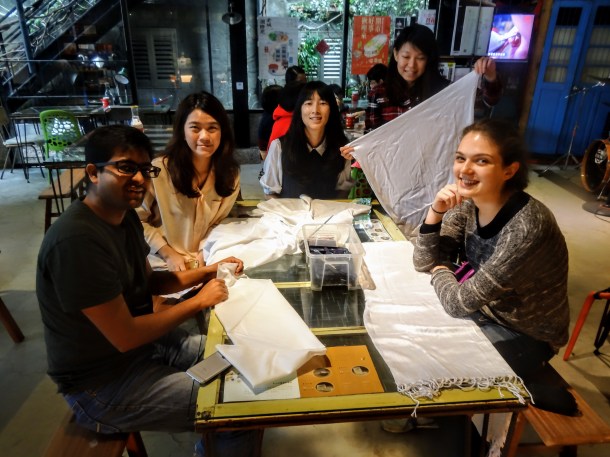
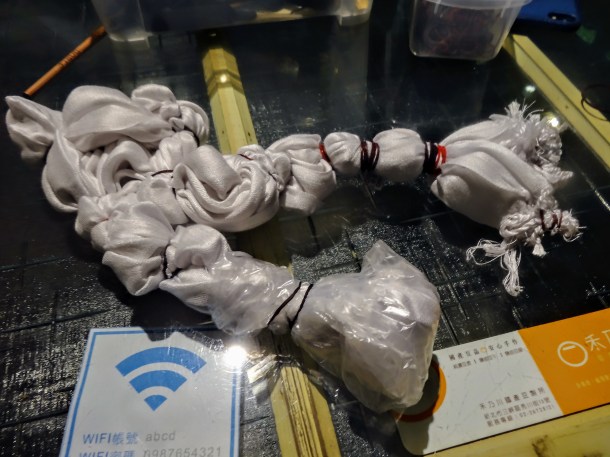
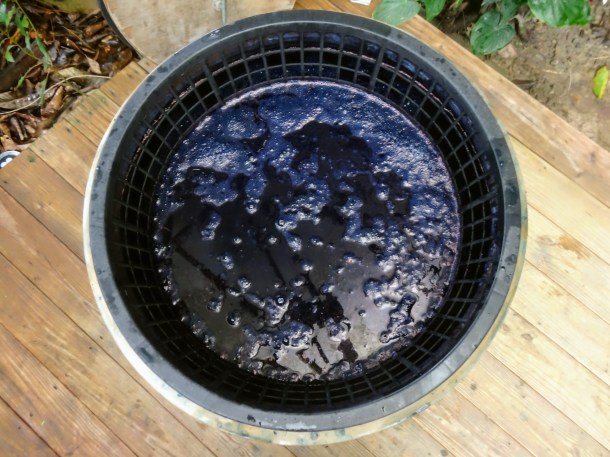
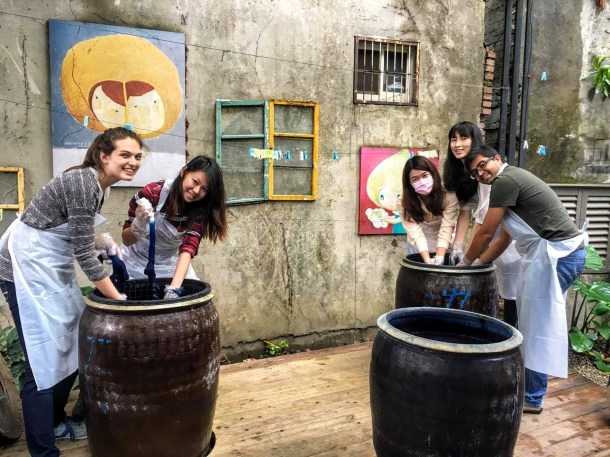
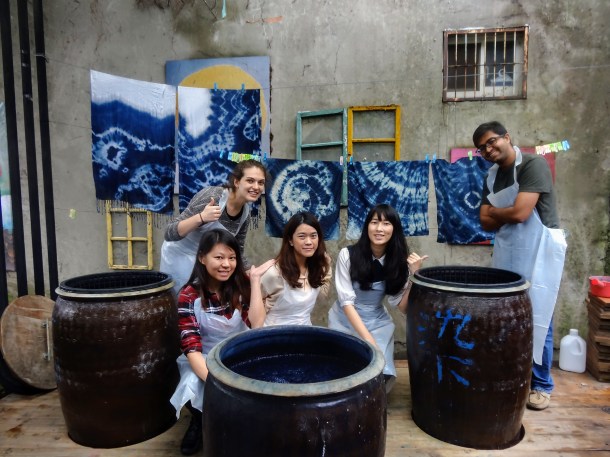
We put on aprons and took our rubber-banded contraptions to the kegs of blue dye and dipped them in for 40 seconds at a time, our hands covered in two layers of plastic gloves. The dye itself looked blue at the top because it was exposed to oxygen, but underneath the blue layer was a dark green liquid. When I pulled the scarf out for the first time, it looked green… until it was more exposed to the air, of course. The longer it was out of the keg of the dye, the bluer the color. We squeezed the excess dye out and dipped it in again, this time not as deep— in an attempt to start the fading effect. While it was in the dye, we also squeezed the cloth. We were told squeezing it while it was in the liquid would make it bluer. We continued dipping the cloth in the dye 40 seconds at a time until the bottoms of our scarves were deep blue. The others finished before us, and as they undid their rubber bands, they unfolded beautiful, geometric patterns in their cloth with perfect symmetry.


Taking the bands off the scarf was like unwrapping a Christmas present— I was excited to see what was inside. What patterns had the twisting and scrunching of the cloth created? Removing the rubber bands from the tassels was tedious, but created a contrast from the rest of the scarf as the employee had recommended. Finally I was able to open the whole cloth, revealing splotchy white bursts in the faded blue dye. It was hard to believe that with cloth, dye, rubber bands, some cheap tools, and a short tutorial, anyone could make a fairly professional looking piece of art.

After we dyed our boutique-looking cloth, we got lunch. At lunch, Sonia’s friends let us try some horn-shaped croissants that were famous in this area. The outside was crunchy, yet the inside was soft and light. There were many bakeries that sold these pastries around this area.
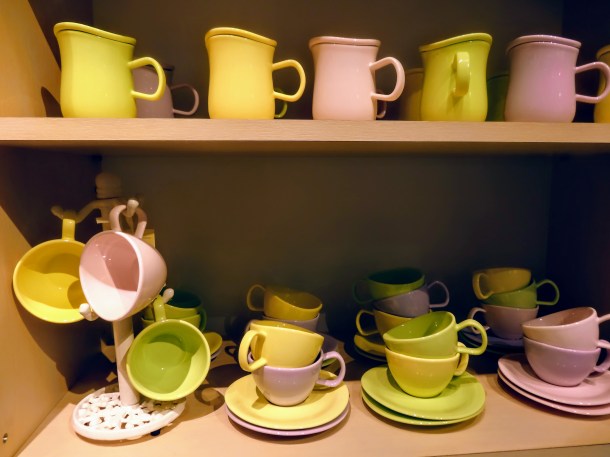
Following lunch, we headed to Yingge, the town known for pottery and ceramics. I had been to the ceramics museum here three years ago with TUSA, but this time with my small group of friends, we’d try our hand at making pottery. We arrived at Shu’s Pottery, where the entrance had all kinds of colorful ceramic plates, cups, and bowls on display.
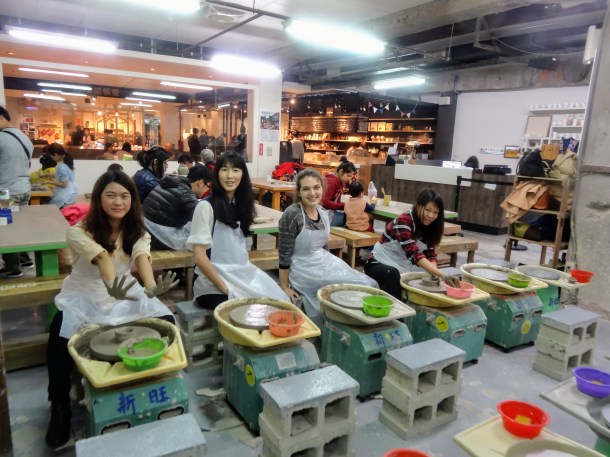
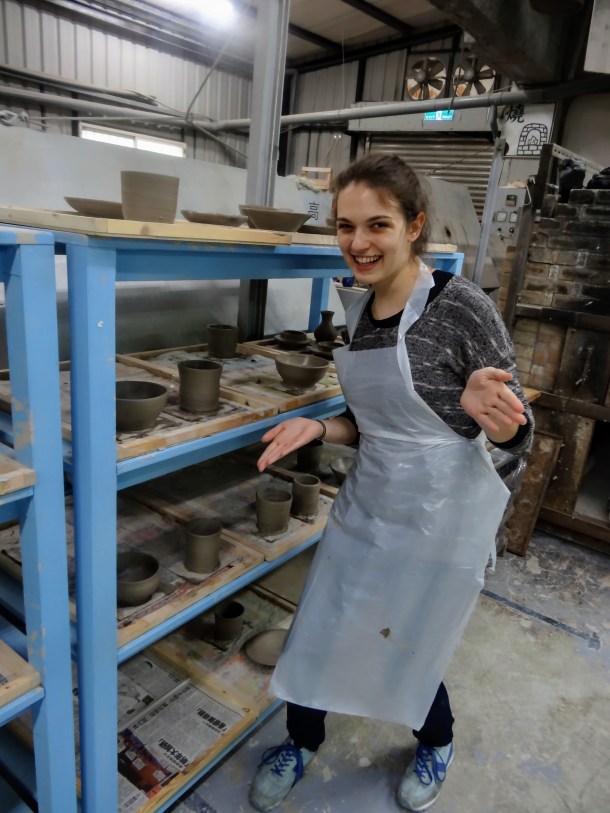
After we walked through the display section of the shop, we got to the dirtier, grittier area where people actually sculpt the clay. Cinderblock stools sat behind a line of pottery wheels, as gray-handed people carried their clay creations to a firing stand. We were ushered to a row of pottery wheels and got a short demonstration of how to sculpt the clay into a simple bowl, cup, or plate. The employee lightly touched the ball of clay, narrowing her cupped hands to make it taller, and pressing in with her thumbs to make it concave. She made it look so easy. A light touch transformed the spinning clay like metamorphosis. I watched it get wider and taller right in front of my eyes.


She told us to grab a slab of clay and try for ourselves, but it wasn’t so easy. The clay slipped from my grasp and slid unevenly under my cupped hands. I was trying to contain it, where I had watched her freely guide it into place. I couldn’t seem to get it. Even after I morphed it into a stout mushroom shape and pressed the pads of my thumbs into the center like she did, it dodged my guidance and did a crazy dance until it spun out of control and I had to halt the wheel and scrap the clay.


I think the employees were bored of the visitors’ lack of skill because when I asked for help, they just made it for me. Their strong fingers made a perfect cup in just seconds, where my clumsy hands couldn’t nail it down after several attempts. We had the option to buy the pottery “we” made, but since it wasn’t truly my own work, I didn’t buy it. Instead I got a $2 bowl imported from Japan that was decorated in baby blue cherry blossoms. It seemed like a good-sized bowl for fruit, so I considered it a justified purchase.


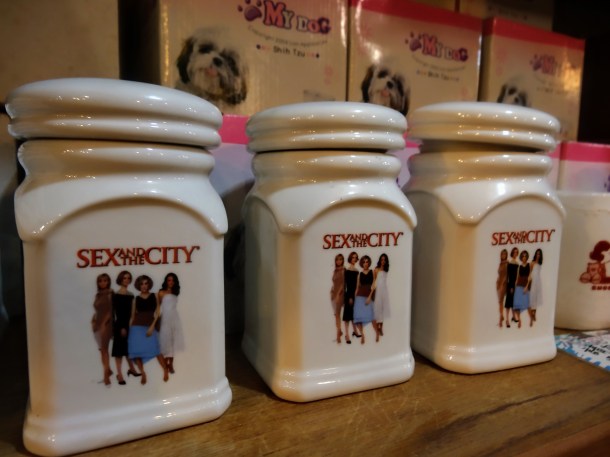
After the pottery experience, we walked around casually looking in shops on the street dubbed “China Street.” Sonia and Sylvia bought some ceramics. The shops had every size, color, and shape you could imagine. I wondered how they stayed in business because each dish was inexpensive, there were so many identical shops around, and how many pieces of pottery do people even buy? Nonetheless, China Street was full of these shops, some of my favorite pieces being the most random and unexpected. One shop had Sex in the City jars and another shop had matching male and female banana bowls.


It was starting to get dark, and I had another commitment in the evening. So Sonia drove me to an escape room, where I met the Cherry Blossom Crew and a couple other board gamers. There were seven of us total, and we were challenged with escaping temporary confinement and saving a planet from destruction in 60 minutes. The first room had multiple puzzles involving a set of Star Wars Lego people, a projection with numbers on the wall, and keys falling from holes in the ceiling.
When we managed to get into the second room, we had to put glowing sticks on the wall to create roman numerals, all which helped us get into the third room, where we had to solve a grid with matching patterns. We managed to escape in 58 minutes and not destroy the planet! There were alternate endings, one of which ended in self-destruction. I think we were just lucky on that one because we actually solved the puzzles for both endings; we just happened to solve the “perfect ending” puzzle first.

It was a day full of activities! Cloth dying, pottery wheels, and escaping imprisonment on a foreign planet… you might as well call me Allison the escape “artist” 😉
 Mandarin Allison
Fun outing. Glad you got to use your artistic skills some. Nice pun on “escape artist” title.