
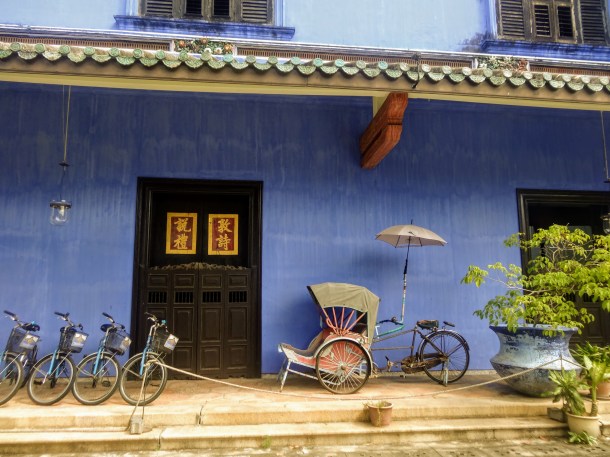
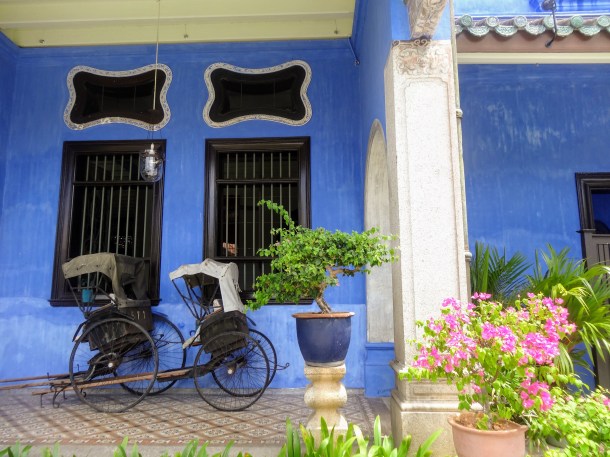
The next day, we started off at the Cheong Fatt Tze Mansion, the indigo-blue house mentioned in the last post. With 38 rooms, five granite-paved courtyards, seven staircases and 220 windows, it was a sight to see. A guide brought us around to each room of the house and divulged all the details and money that went into the making of this gorgeous home. When Cheong Fatt Tze died, the house was passed on to his descendants, who didn’t take care of it. It came to be full of squatters and was almost demolished until a group of local Heritage Preservationists purchased it from his descendants in 1989. Close to $1.8 million (USD) went into the restoration of the building. The center of the mansion had an open-air ceiling, so when it rained, water came pouring into the middle of the building. This was because in Chinese culture, water is linked to money, so to have the water pour into your home is to bring wealth upon the people who live there.

This is where the rainwater would collect
We learned about Cheong Fatt Tze’s multiple wives (the seventh was his favorite), and saw the detailed carvings on furniture decorating the house. It was neat to meander through such an ornate, beautifully restored building that had melded European and Asian influences so uniquely.
Next we decided to head over to Fort Cornwallis. On the way we passed the Cenotaph, which is a war memorial dedicated to the fallen allied soldiers of World War I. Next to it was City Hall, a large, Baroque-style, white building built in 1903.
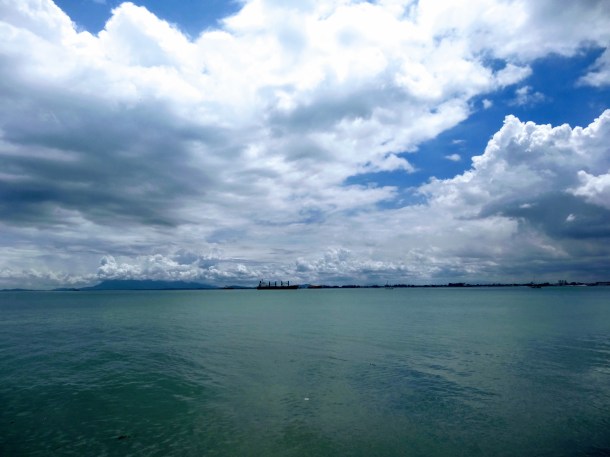
A view from the walk
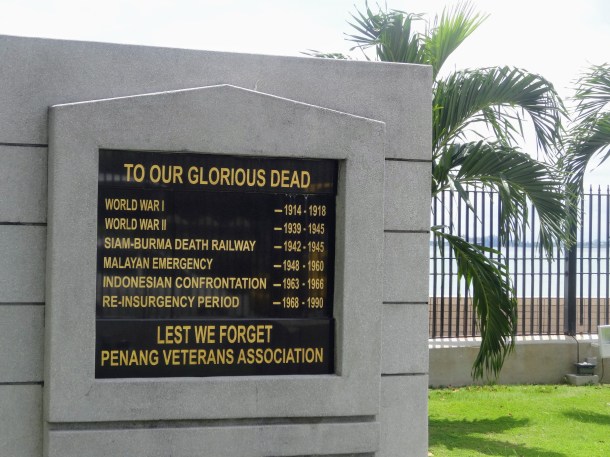
An overview of Malaysia’s tumultuous history, little taught in the U.S.
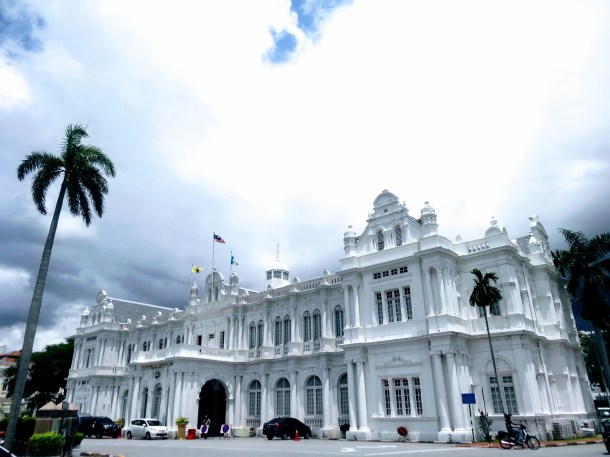
City Hall
Finally, we reached Fort Cornwallis, a true “fort” with brick walls and cannons. It was built in 1786, and was in use between the years of 1786 and 1881, yet it never actually engaged in combat. It was built by the British East India Company to protect the nearby port, and subsequently named after British Army Officer Charles Cornwallis. At the time, Cornwallis was the Governor-General of Bengal. We walked the grounds and explored inside the various rooms.


Next, we walked to the Clan Jetties. A “Clan” is a group of Chinese people who share a common last name and ancestor. The Clan Jetties are old Chinese settlements built on the waterfront.

Many of the houses are supported by stilts in the water. Each of the six remaining Clan Jetties are occupied by a different Chinese Clan. They were originally built in the 1800s to house port laborers who were too poor to afford housing on land. Unfortunately, the landscape has changed and evolved, so what is there now doesn’t really reflect the original Clan Jetties. The area has become commercialized to cater tourism, so there are many snack and souvenir shops along the boardwalk. We walked around the boardwalk, which was desolate and quiet. There weren’t many people around and most of the shops were closed. Maybe so many shops were closed because it was the rainy season— I’m not sure. We looked out on the water. I can’t imagine living in a home supported by stilts on the Malacca Strait. It would be so, so different from the life I’ve lived. Crazy to think that if I were born here, everything I know from my life experience today would be completely different.
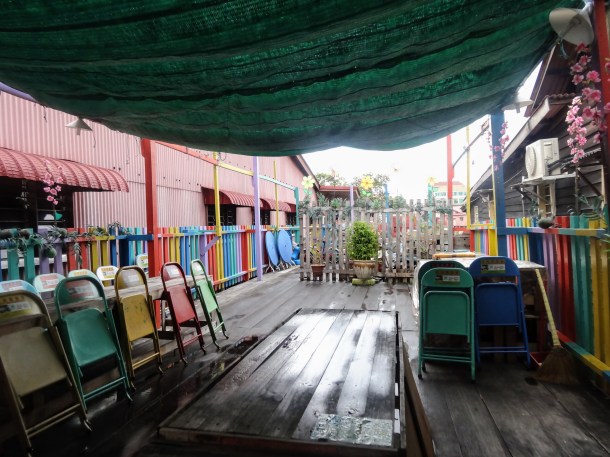
A colorful boardwalk on a rainy day

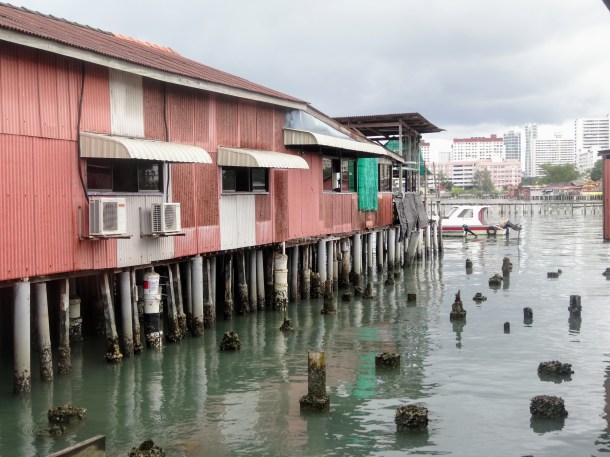
Houses built on stilts
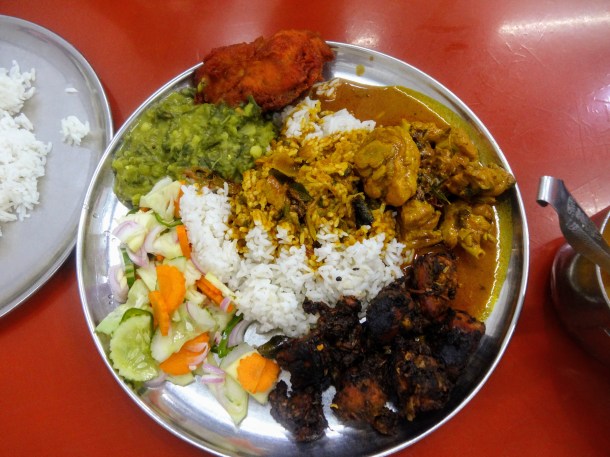
After the Clan Jetties, we headed over to Little India. The scent of Indian spices and upbeat, Bhangra-style music blaring from storefront speakers filled the street. Dresses, flowers, pastries… everything at the storefronts were boldly and brightly colored. We ate at a buffet style restaurant where they served us portions of what we requested on a circular, metal tray. On our way out, we picked desserts of all different shapes and sizes from a glass case. I picked out one cube-shaped dessert that turned out to be like fudge.

Little India

An apartment building in Little India
I nibbled at the sugary block as we walked out of Little India and back into central George Town. We came across the Sun Yat-sen Museum, and being our curious, Taiwan-intrigued selves, paid a small admission fee to learn about the famous Chinese figure’s impact on Penang. Sun Yat-sen is highly regarded in Taiwan, often called their country’s “National Father.” The Sun Yat-sen Memorial Hall is one of the most iconic monuments in Taipei. It turns out that he planned the Xinhai Revolution (or Chinese revolution) in Penang, Malaysia, at the location of the museum. That revolution overthrew the Qing Dynasty (China’s last), and established the Republic of China in 1912, which included Mainland China, Taiwan, and Mongolia. The turning point of the revolution occurred on October 10th, a national holiday in Taiwan known as double ten day.
After we checked out the museum, we headed to the Khoo Kongsi Clan House, a highly decorated Chinese clan temple. Again, clans are groups of Chinese people who share a common ancestor, and the Khoo Kongsi Clan house, still in its original location, is a prominent display of Chinese culture and influence in George Town, Penang. There wasn’t too much about the Khoo Kongsi Clan House that was different from other Chinese temples. There was information inside the building about the Khoo Kongsi Clan, but we didn’t stay there very long.
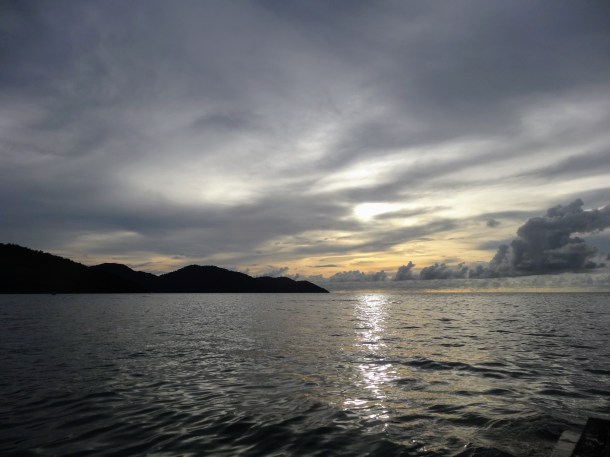
Next we headed to Batu Ferringhi, a beach resort area on the island of Penang. It was a little bit of a drive from George Town, but worth it. The coast was beautiful and we stayed to watch the sunset.

Jack says, “Hello!”
The strangest part about walking down the waterline was seeing all of the Middle Eastern families on vacation there. Packs of women covered head to toe in niqabs were sitting on towels in the sand while their husbands and kids played in shorts and swimsuits. There were several times we saw one man with multiple women, but since they were so covered in clothing, it was hard to tell if they were multiple wives or just other family members, like sisters and aunts. It was weird to see so many women covered up in a place where I was used to seeing them in bikinis. We walked down one of the piers and watched a man cast a wide net and reel in a ton of flopping, squirming fish. All the kids gathered round to watch. Then we saw a woman in a niqab take a plastic bottle out of her purse and throw it into the water, as if that were a perfectly acceptable place to dispose of it. I’ve never seen anyone so blatantly throw trash into nature like that. It made me think about how she’s probably never been taught why littering is bad, or if she has, she just doesn’t care. And that made me think about how your upbringing and the culture you’re surrounded in can be so drastically different depending on where in the world you grew up. Just on that action alone, I knew we came from very, very different places. We watched the sunset cast glowing halos on the silhouettes of clouds before we headed back to George Town.
That night we went to an authentic Chinese food restaurant, which served dumplings and other small dishes from a cart. I was pretty tired of Chinese food after being in Taiwan for a year, so I didn’t eat very much. Jack enjoyed it though. Afterward, we packed our bags for an early departure to the island of Langkawi the following day…
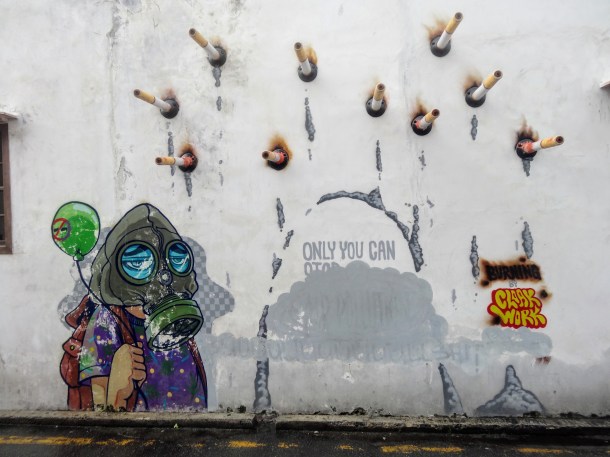
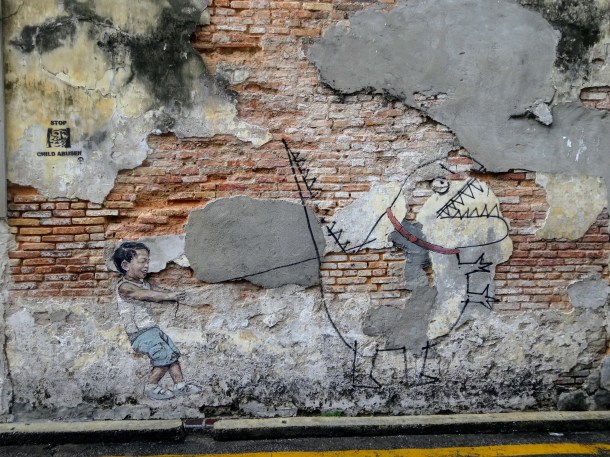
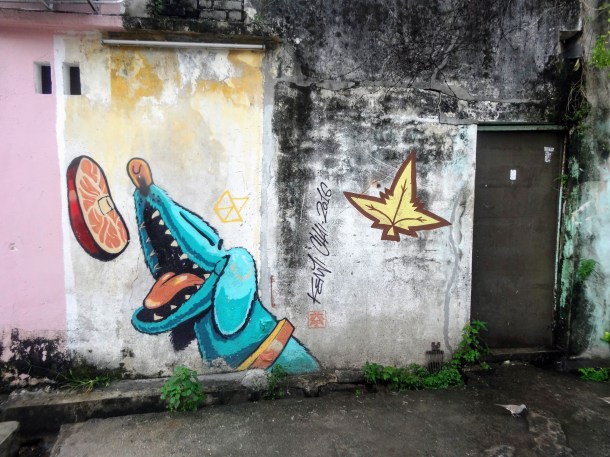
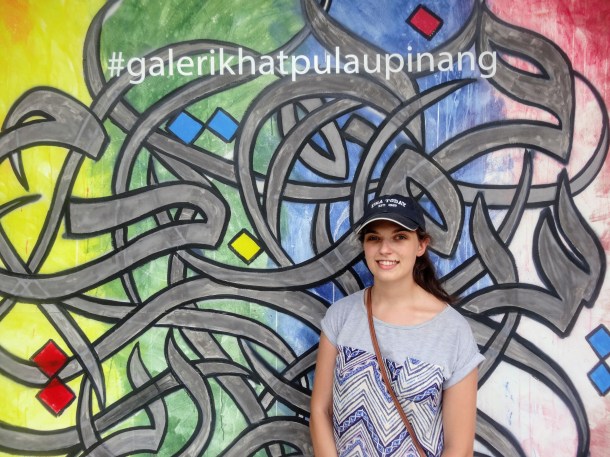
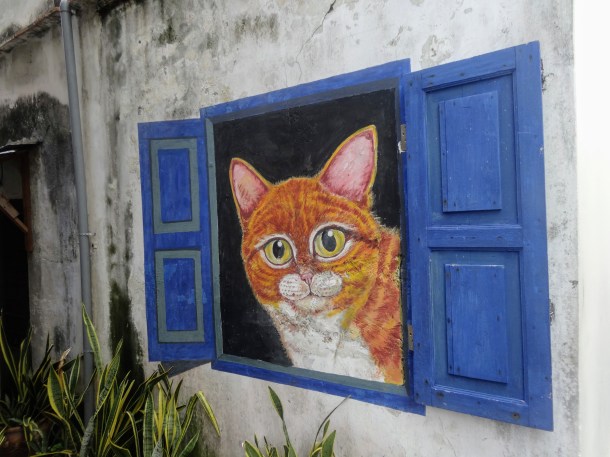
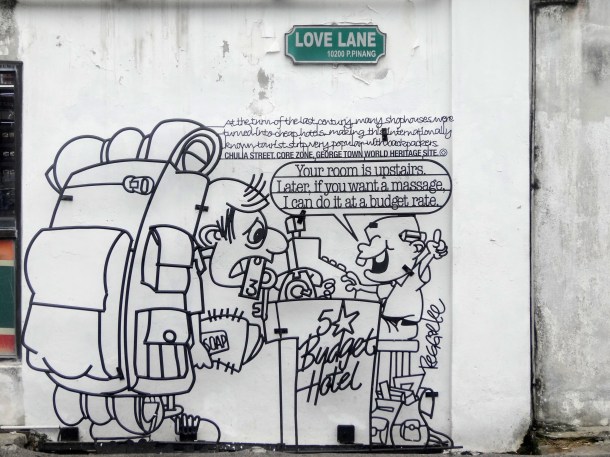
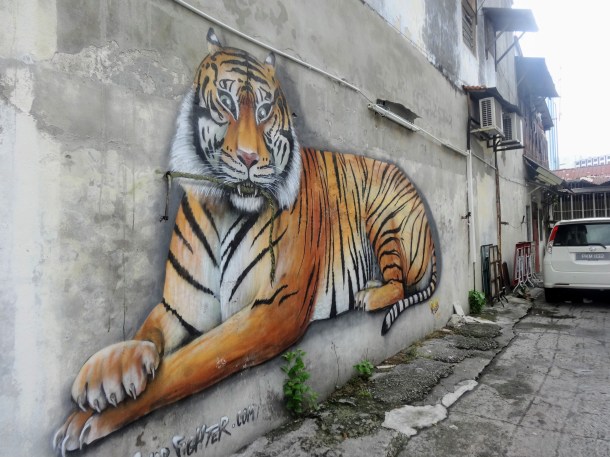
However, before I conclude my overview of Penang, it only feels right to feature some of my favorite street art. Notice how many of the pictures include both two-dimensional and three-dimensional elements, the art playfully interacting with physical objects like bicycles and the surrounding architecture, like chairs and window shutters. The street art always kept you on your toes as to what was real and what was just an image painted on the wall. Art intertwined with their already colorful architecture spawned an adventurous desire to explore random alleyways because you never knew what you’d find around the corner. I hope you enjoy the snapshots of street art I stumbled upon in Penang:





 Mandarin Allison