We boarded our comically short flight (45 minutes). Dan ordered food for us when he was booking our tickets because it was cheap. We proceeded to have a mess of a time trying to scarf down our meal, dessert, and fill out the immigration documents before the plane landed. Cambodia had even more immigration documents than the other countries because we needed a visa upon arrival. Immigration papers, food containers, and water bottles were everywhere. Between the four of us, we got at least six bottles of water with our meals and desserts. The plane landed, and I was able to take the mango sticky rice dessert with me. I couldn’t let that go to waste.
When Dan took out cash in Cambodia, to our surprise it was in U.S. dollars. They apparently use U.S. currency in Cambodia, and give Cambodian cash equivalents for change and small bills. It’s an odd system, and I kept a couple of Cambodian bills as souvenirs. The visa on arrival was an assembly line: pay, move down the line, and collect your passport. Despite Siem Reap having a small airport, the line for customs was probably the slowest of our entire trip. When we were through, we hopped in a cab. Our driver happened to be very good at English, and funny too. He told us about a lot of spots we can visit and a little bit about how much Cambodia’s changed since he grew up. Cambodia has a vivid war and political history up until very recently. I will talk more about that later in the post.
He dropped us off at our hostel, Onederz, and we put down our things in the room. It was a quiet floor; I don’t think I saw another person in the shared bathroom the entire time we were there. The hostel was full of young backpackers traveling around to the same places we were going, and the lobby had its own breakfast restaurant. There were also two pools, one on the roof and one on the main floor of the opposite building.
Excited to be in Cambodia, we headed out to Pub Street. On our way out we talked to a guy who was drinking alone, depressed about not traveling with his girlfriend, and a friendly Italian guy. Zack and I were secretly glad that the depressed guy didn’t accept Dan’s invitation to join us on Pub Street. He seemed like kind of a downer. That was nice of Dan to ask though. At this point it was late, so Pub Street had reached its crazy, after-hours status. It was a narrow, unpaved road. The loudest music I’ve ever heard blared from both sides of the road, and I needed to cover my ears. Flashing, colored lights were everywhere. I saw a little kid walking around. It seemed like this was the place for drug deals. We headed away from the madness and Dan told us to never talk to kids on those kinds of streets— they’re pickpocketers. We got drinks down the street at a quieter location. Josh and I got fruit smoothies and Zack and Dan got beers. It was an interesting first night in Cambodia. People watching here was top-notch— we had a great time pointing out all the people who looked like they came here to do mushrooms (or were on mushrooms currently). It was nice to go sleep that night not needing to wake up early for a tour. For the first time in our trip, our next day would be more relaxed and unplanned.
We slept in and began our first leisurely morning with a breakfast at the hostel’s restaurant offering pancakes, omelets, and fresh fruit smoothies. Shortly thereafter, we did some preliminary research on what we should do that day. I found a half-day countryside bike tour that seemed like it would take us away from the tourist center of Siem Reap for a bit, and we signed up. Then we headed out for something everyone should do while they’re in Asia: a fish massage.

A fish massage is where you submerge your feet into a tank and fish bite the dead skin off of your feet, leaving you with smooth skin if you can endure the tickling of their fish lips. There was a fruit smoothie stand RIGHT next to the fish massage place, so I couldn’t resist. Mango smoothie plus fish massage is a winning combination. We all sat on a cushioned bench facing the street with our legs dangling into the fish tanks. Apparently Dan and Zack had larger fish in their tanks than Josh and me because they kept saying it really hurt, and Dan had a bit of a rash afterwards. I like to think that their fish weren’t bigger and we could just take on the fish better, but that’s probably not true.

After our fish massages, we walked around the street vendors’ tents. Every stall had elephant print pants and stuffed animal elephants. There were also stalls showcasing incredible paintings of jungle animals and temples. Zack considered buying an epic close-up acrylic painting of an elephant’s face, but ultimately decided against it. We all bought elephant print pants in preparation for the Angkor Wat tour we had planned the next day. Then we walked back to the hostel and got ready for our bike trip.
A tuk tuk picked us up outside our hostel, and we discovered very quickly that we could have walked to the bike shop since the trip was an embarrassingly short two minutes long. Oh well. They suited us up with helmets and bikes, and introduced us to our tour guide. He was really friendly and informative. In case you ever go to Siem Reap, his name was Hean G Ra with “Unique Adventure— The Cycle Tour.” We biked down the unpaved, residential roads outside the small city center of Siem Reap and it wasn’t long before we were out in the country, rice paddies on either side of us.


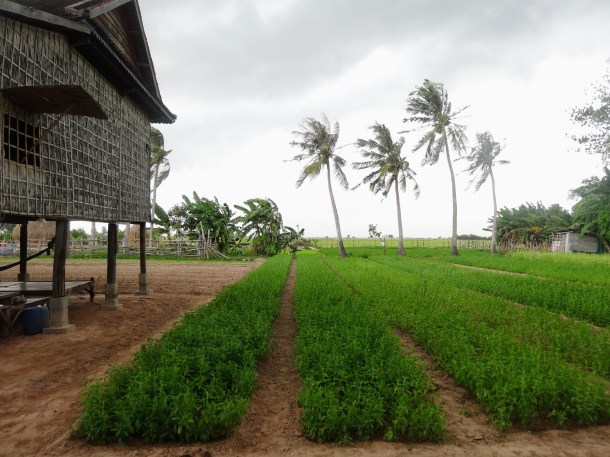
Cambodian kids ran from their yards to come say “hello” to us in English. They were so excited to see foreigners. We stopped at a farm where Hean showed us the long beans growing there. They were the longest beans I’ve ever seen! They were about a foot in length if I had to guess.

Those are some long beans!
We hopped back on the road and passed Angkor Wat Putt, a miniature golf course with replicas of some of the temples inside the Angkor Wat complex. We didn’t know at the time, but we’d play that course the following day. Then, up ahead we saw a large group of people heading toward us, so we pulled off to the side of the road.

Hean explained that when someone dies in the community, the entire village walks their body to the cremation site. We saw kids and adults walking down the street in solidarity, some surrounding the casket under a canopy, as a gong rang out. This isn’t my video, but it was much like this:
We ventured on from there and visited a duck farm, where hundreds of ducks were walking around quacking in the fenced area.

There was a quick rain and our guide asked a nearby resident if we could take cover under her house. She kindly agreed, and we walked our bikes under the house, which was held up by stilts. He explained to us that a lot of houses in Cambodia, especially on farmland, are on stilts to protect their property from the large amounts of rain they get there. A donkey was tied to a nearby tree. The 20-minute downpour gave us quite a bit of time to ask Hean questions and tell him a little bit about the U.S. His father had been to America before, but he had never gone. We talked about funny idioms and phrases in English that don’t make sense literally.
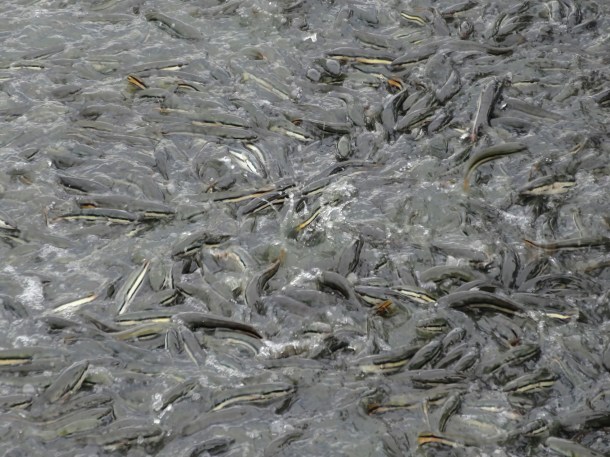
Soon we were on the road again. We stopped by a fish farm, where we got to see the owner feed them. Massive amounts of fish came writhing to the surface, scrambling over and under each other to compete for the food she was throwing into the water. Their slimy scales glistening in the water almost made them look like snakes.
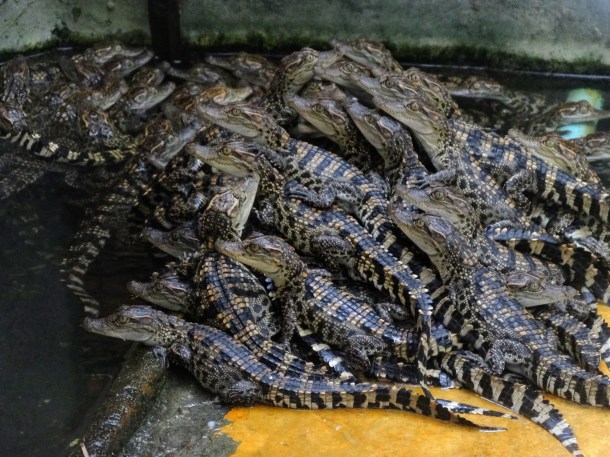
After the fish farm, we biked by a large fire, which Hean said was the cremation of the body from the funeral procession earlier. We biked to a crocodile farm next, where we parked our bikes and walked into the back. The first cage had tiny crocodiles inside, all laying on top of each other. One large, yellow eye stared at you from the side of a long-snouted head, until the crocodile farmer stuck a long rod into the cage to rile them up and they snapped and hissed at each other.
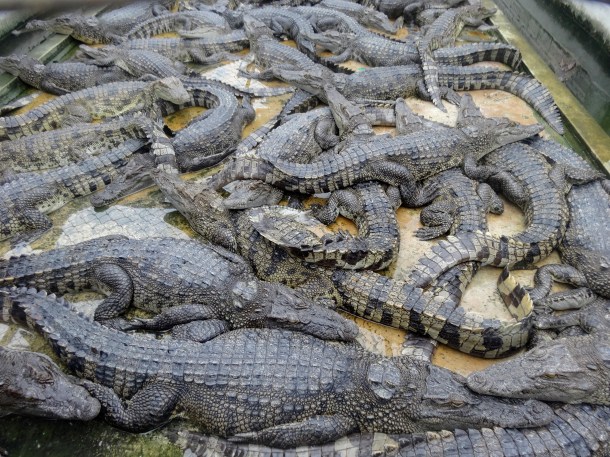
We walked to the next cage with slightly larger crocodiles. It made the other crocodiles look like babies. These were all about the length of an ordinary crocodile, but seeing them so up-close was still somewhat shocking, especially when they got hissy and fought with their sharp teeth on display.

I didn’t even realize there was another area to the farm because there was a wall behind that cage and it looked like it ended there. Turns out, there was a couple of steps behind that cage that led up to a long walkway over the enclosure for large crocodiles. It felt a little bit like “walking the plank” since the walkway was long and skinny, and massive crocodiles waited quietly beneath our feet. When the crocodile farmer used the rod to stir these crocodiles, it was legitimately scary. They pounced with a speed and ferocity so intense that I could easily see how crocodiles kill 1,000 people a year. Crocodile skin is a major export in Cambodia, and the skins are later made into purses, shoes, and belts.

After our crocodile farm excursion, we stopped for a quick drink at a café. I think Dan, Zack, and Josh all thought this place was super sketchy since it was in the middle of nowhere, but I ordered a passion fruit drink anyway. I never got sick, so it was legit. We talked to our tour guide some more, shared stories, and promised a good Trip Advisor review. The tourism industry in Cambodia completely revolves around Trip Advisor and many of these places are a bit obsessive about getting a good review. We truly did enjoy the tour though, so that was the least we could do in return. As we talked, we watched a bunch of Cambodian boys play volleyball barefoot across the street. It was fun to watch— they were having a lot of fun with it.
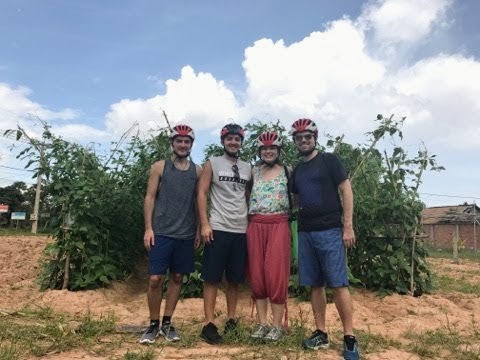
Our last stop on the way back was at a pig farm, and we walked through the smelly building full of pigs of all sizes— gigantic pigs, little baby pigs. I’ve always been a big fan of pigs, so I was excited to see them. I was less excited for what their fate was going to be, but I knew they would probably be providing food and an income to a lot of Cambodian people, so it wasn’t all bad. For the pigs it was… but people do what they need to survive.
On our trip back to the bike shop, it began to rain a little bit. We were so lucky with rain this entire trip. It really didn’t affect any of our plans, despite knowingly going during the “rainy season.” We returned our equipment, thanked Hean, and walked back to Onederz, where we showered and got ready for the night ahead. We had planned to get a really nice Cambodian meal for our first evening in Siem Reap. Dan picked a restaurant located in an artsy alley, colorful umbrellas hanging over the walkway between storefronts.
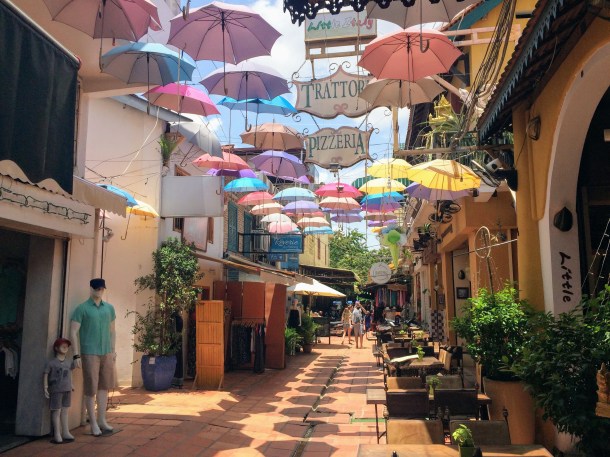
The food was fantastic, and we totally stuffed ourselves. We got fruit smoothies again, and all kinds of Khmer food… skewers of grilled meat, flavorful fried rice, rich curry. It was truly fantastic. We ordered everything we wanted and the bill was still very small by American standards. I wish this restaurant with these prices existed in Cleveland. There actually is a Cambodian restaurant near our house called Phnom Penh, so I will have to go try it.
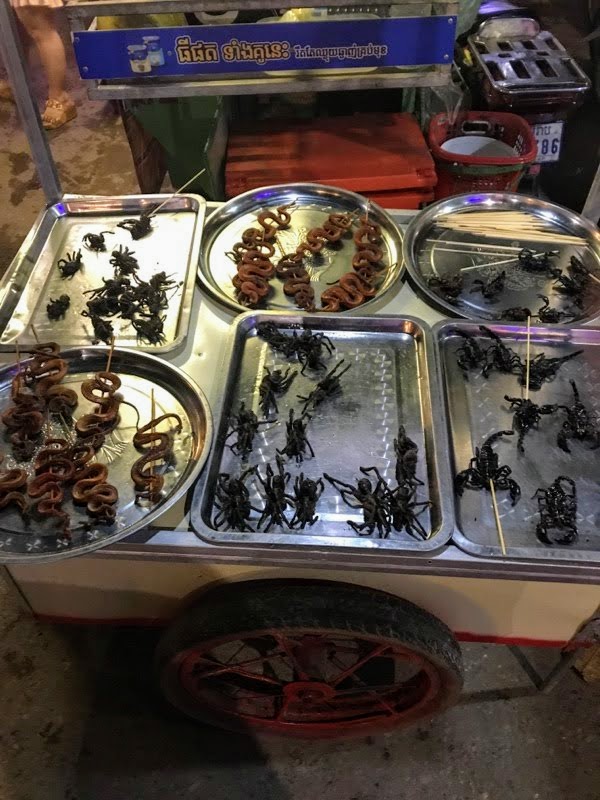
Cambodia is known for incorporating bugs into their food. However, this was not served at the restaurant…
After dinner we walked around more of the storefronts trying to find a specific orange and white pair of elephant pants that Dan had his eye on. We never quite found the exact pair he wanted though. That night we headed to bed on full stomachs for what would be another leisurely morning in Siem Reap.
The next day, Zack, Josh, and I went to the rooftop pool while Dan booked some of our Vietnam plans online. In the afternoon, we went to the War History Museum, which featured tanks and weapons used during the Cambodian Civil War from 1970 to 1975. Quick reality check: that was just 42 years ago. It’s crazy to think that an evil regime was murdering the people of Cambodia, the country we were standing in, during my parents’ lifetime. The war pitted the Khmer Rouge and its allies (Northern Vietnam and the Viet Cong) against the Kingdom of Cambodia and its allies (the United States and Southern Vietnam). It was one of many surrounding areas wrapped up in the Vietnam War conflict. In the end, the Khmer Rouge prevailed and Pol Pot led the Cambodian Genocide between 1975 and 1979. During these years, anyone with connections to foreign governments; people with an education; people who knew another language; people who wore glasses (included under the umbrella of intellectuals); Vietnamese, Chinese, Thai, and other ethnic and religious minorities; and former city-dwellers who couldn’t contribute to farming were all targeted. An estimated 1.5 to 3 million people were executed and buried in mass graves called the “killing fields.” We visited the killing fields later that day, which I will get to later in the post. Finally, in 1979 the Vietnamese army invaded Cambodia and overthrew the Khmer Rouge. Pol Pot and his forces retreated to the jungles on the border of Thailand. Pol Pot then clung to power through a coalition government that was internationally recognized as ruling the country until 1993. The UN Transitional Authority helped set up a new internationally recognized government with a free election, and 90% of eligible Cambodians participated in the May 1993 election. Pol Pot was placed under house arrest by a faction of the Khmer Rouge, and there are still rumors circulating about his death. Some believe he was poisoned, some think he committed suicide. He died in 1998 after Ta Mok, a Khmer Rouge military chief and soldier, took him into the jungle fleeing a government attack.
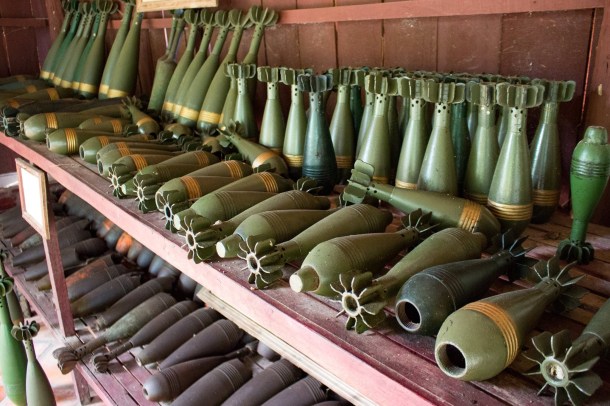

After three decades of war, Cambodia now holds more than 40,000 amputees and 4 to 6 million unexploded landmines. At the museum, all of the guides were war veterans and gave free tours. Our guide, Moun Sinarth, still had a small square of grenade shrapnel showing through the skin on his leg. He pointed out the hard, square bump and asked us to feel it. He said it was originally higher up his leg, but over time it has moved down. He is known as “the cat” for having more than nine lives after surviving rocket propelled grenades, AK47s, multiple landmines, 58 hornet stings, and a motor accident with a cow. All of that has resulted in scars, shrapnel in his body, losing his right leg, and even a tiny piece of his foot bone lodged in his eye. Just this year he discovered a landmine only 30 meters from his house. And for the last 16 years, he’s driven 38 km to and from the museum on his motorbike to give tours.
Now he has a book called Sinarth detailing his life and wartime experiences. He pointed out the guns used in the war, and let us hold them to feel their unexpected weight. Everyone’s hands dropped a bit with the gravity of the weapon when they took the gun in their hands. Our guide also touched on how landmines are sprinkled all over the country, and some Cambodians find them in their backyards to this day. It’s hard to believe 4 to 6 million explosives are lurking beneath the ground awaiting their next victims. Now that the wars are over, the landmines are a constant reminder of the horrors of the last three decades, haunting those who survived the era of Civil War and Pol Pot.

Moun Sinarth, our guide
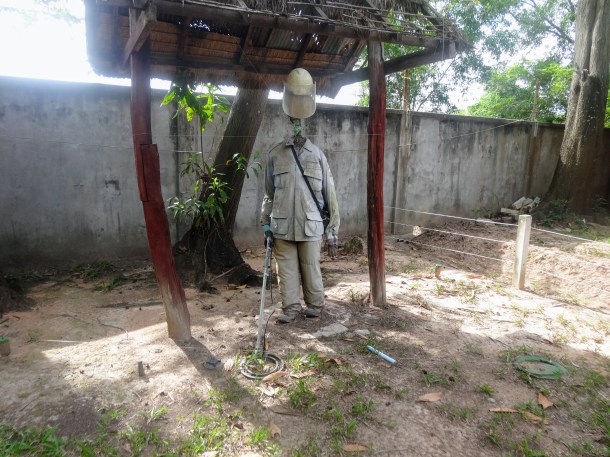
Once the tour was over, we walked around the museum grounds looking at the large, rusted tanks. We talked about the Vietnam War and if the “horrors” of communism were worth all of this violence. Dan had already been to Vietnam, one of only five communist countries left in the world, and described its cities as bustling and thriving. What would have happened if the United States had just left them alone and never intervened? Would the countries we “saved” from communism have turned out the same way, better off, or worse off? It’s hard to know, but I think we all felt it was sad that so many lives were lost over something as trivial as a disagreement over the best economic and political systems.
After the museum, we headed to the killing fields. A long billboard of information about the victims stood near the entrance. In the center of an open plaza stood a glass case, showcasing piles of skulls of the Khmer Rouge victims.
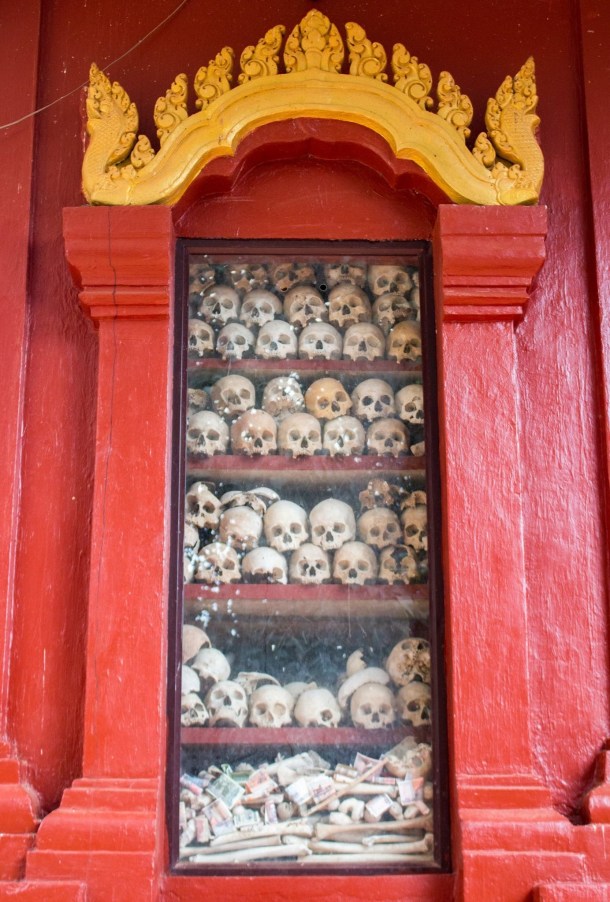
This location was one of many sites where Pol Pot’s regime killed and buried 21 percent of the country’s population during his reign, as mentioned above. The display case pretty much spoke for itself. It was so sad to think about.
As a quick respite from the overwhelmingly sad material, we grabbed some ice cream cones from a local vendor who pulled out plastic chairs for us to sit in. It was nice to sit in the shade with an ice cream after the weighty content we covered that day and the Cambodian sun.
After that, we decided to head somewhere a little happier: Angkor Wat Putt, a miniature golf course with holes modeled after temples in the famous Angkor Wat complex, where we’d be heading the next day. Upon arriving, we were greeted by American rock music ringing from the speakers and the friendly, happy-go-lucky owner of the putt-putt course. He welcomed us to try to beat the course’s low score records displayed on the wall and showed us to the clubs and balls. We headed to the holes adorned with mini replicas from the grounds of the Angkor Wat complex, with an added incentive: we’d get a free beer for every hole-in-one. None of us got on the top-5 leader board or won free beers, but we all had a lot of fun trying.

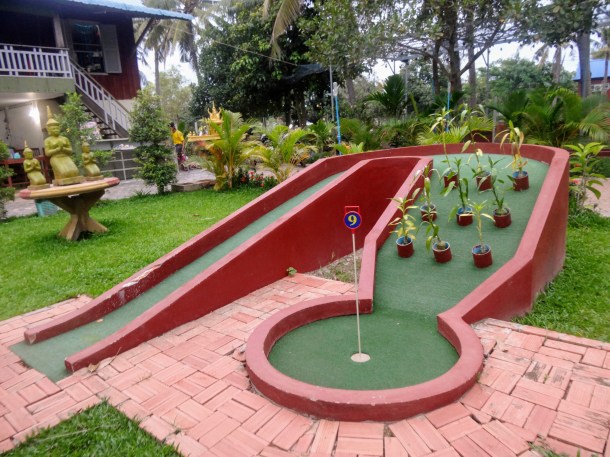


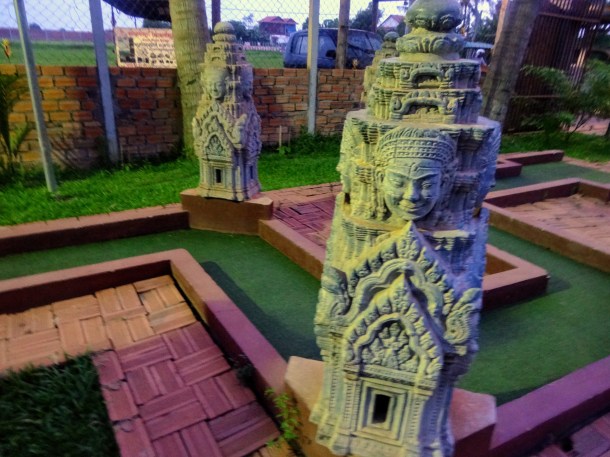
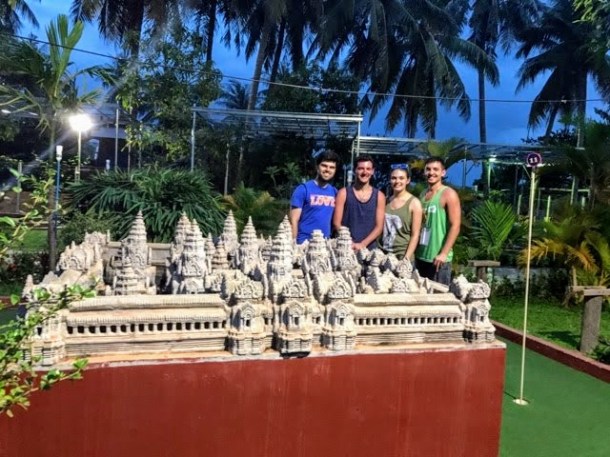
That night we went to a fancy restaurant we had staked out the night before on the walk home. Elephant statues decorated the entrance and we shared all the dishes family-style. After dinner, Dan, Zack, and I went for our usual nighttime massages. I was given my own private room! It was the perfect way to relax before our early morning tour of the Angkor Wat complex.
 Mandarin Allison
My dad was in the army fighting Pol Pot back in the day… He drank water from a well with skulls floating to the surface minutes later