We arrived to Hiroshima via the shinkansen (bullet train) and rode a tram to our hotel. The tram system was established in 1910, and after the atomic bomb devastated the city, it was back up and running in just three days. The trams here symbolize survival and rejuvenation, according to BBC News. When we arrived, the weather was gloomy and overcast, with rain coming down and ominous crows flying overhead. People with umbrellas paced in front of muted-colored buildings. I couldn’t help but feel that it was fitting— this city will forever be associated with one of the most tragic events in history. The mood of the city felt somber and cold on our way to lunch.
We stopped at a small Japanese ramen shop called Matsuba, having to wait outside for tables to clear. This was our first ramen of the trip, and despite not really knowing what I ordered, I was more than pleased with what was delivered on the bar in front of me. A perfect combination of noodles, broth, and spices steaming in a large bowl made me feel warm and cozy inside the tiny restaurant, especially after standing outside in the cold to get a seat.

We headed to Hiroshima Castle next, where certain trees had been marked as survivors of the atomic bomb blast. Resilience seems to be a major theme for the city, perhaps out of necessity. We also walked by the stone foundation of an original building on the castle grounds that survived the blast. The 5-story main keep was rebuilt, and turned into a museum displaying a multitude of samurai swords, and diagrams of castle defense systems. Many castles has spikes on them to prevent intruders from climbing up the side. Some castles also had a large chute for dropping large rocks onto the enemies below. And of course, many castles had built-in areas to point the barrels of cannons at oncoming troops. Sometimes they would aim the cannons at a mound in front of a smaller, first moat and fire to purposely flood the approaching troops. The view from the top of the castle was hazy and it was hard to see much past a few of the adjacent buildings. The amount of history in the museum was a little overwhelming, and paired with the weather, it made us really exhausted. So we headed back to the hotel, where I proceeded to take a four hour nap. We have been so busy the last two weeks that I really needed to catch up!

After waking up, I realized that Federer and Nadal were already well into the final match of the Australian Open, so I quickly turned on Slingbox. I was pleased to see it was just 1-1. I grabbed my potato chips and grapefruit Strong Zero (a drink recommended by Tom in Tokyo) and watched the five-setter, dry inside the hotel room on this rainy day.
I was sad to see Rafa lose, but all the while happy for Federer. It was pretty cool to see him win another major seven years later, somehow still able to best the players in their prime at 35-years-old. It’s clear he genuinely loves the sport, and plus, I think the crowd was hoping for a Federer win.
Finally, we set out for dinner close to 9:30 pm. A building filled with okonomiyaki (Japanese pancake) restaurants called okonomi-mura was rumored online to be open past midnight, so we were hoping that was true. We thought maybe not on a Sunday night, but we were wrong. A man greeted us outside with a menu and took us up to his grill, along with his drunk friend who had stumbled in around the same time as us. The cook was a former olympic boxer for Japan in the Moscow olympics, and had photos of himself in the ring hung along the walls.
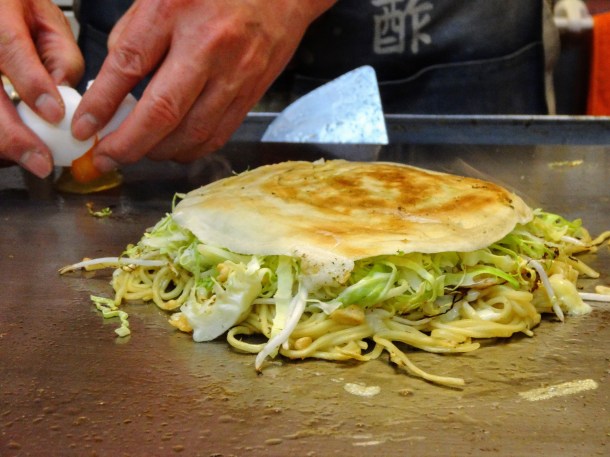
He explained the menu since we were okonomiyaki beginners, and we chose our noodles and toppings. We watched him fry things on the grill, and the stack of ingredients on the pancake slowly get taller through each step of the process. It started with a thin layer of batter, then a generous handful of cabbage. Next, slices of pork, and after that, a helping of noodles. Finally, an egg, and two different sauces decorating the top in a criss-cross pattern. He handed us mini spatulas to serve ourselves off of the edge of the grill and onto small plates. It was a ton of food, and we were entertained throughout the whole process (pre-okonomiyaki to post-okonomiyaki) by our drunk companion, a Japanese man in his 60s who was actually not too bad at English. He sent his wife a picture of all of us at the restaurant, along with an audio recording of Brian defending him/asking her not to be mad at him when he comes home. It was pretty funny. When we told him Cleveland was famous for a rock n’ roll museum, he quickly jumped to his playlist and started playing different Elvis tunes, like Blue Suede Shoes and G.I. Blues. He estimated Brian to be 27-years-old, and me to be 22-years-old. We decided the beard made Brian look older than he really was. I was glad to be thought younger than I really am. If I can keep that up forever, I’ll be in pretty good shape. I asked the cook how late he stays open, and he told us he opens at 8 p.m. and basically stays all night long, cooking for anyone who comes. It seemed like our drunk friend would be here a while longer. The cook even knew the drunk man’s favorite dish (his wife’s specialty). The cook quietly claimed to us that his friend is scared of his wife and that’s why he comes here.


Full and tired, we headed back in the rain and got a full night’s rest before the heavy day slated ahead of us. Tomorrow we would go to the Atomic Bomb Dome, the Hiroshima Peace Memorial Park, and the Hiroshima Peace Memorial Museum.
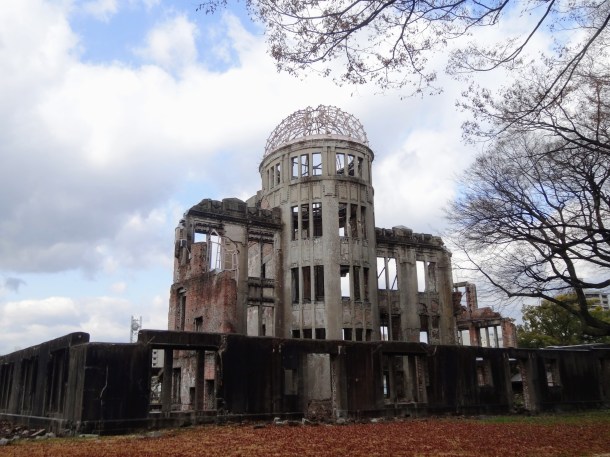
The Atomic Bomb Dome is the most famous building in Hiroshima, and one of the most famous in Japan. The bomb detonated 600 meters directly above this building at 8:15 a.m. on August 6, 1945. Originally completed by Czech architect Jan Letzel in 1915 as the Hiroshima Prefectural Commercial Exhibition Hall, it later became an office for the interior ministry, lumber control, and other government agencies. Because the building, at the time named the “Hiroshima Prefectural Industrial Promotional Hall,” was directly under the explosion, it avoided complete incineration, and the iron frame stayed intact. It was controversial whether to keep the building standing as a memorial and symbol of endurance, or whether to destroy it as a harrowing reminder of tragedy. After much debate, the memorial backers persisted, and the dilapidated building remained. It was mind boggling to comprehend that I was standing where one of the world’s only used atomic bombs had detonated 72 years ago. I wondered what the same site would have looked like then. The museum would explain that picture through moving stories of children and families in the 1-mile radius that was destroyed. Now, the city was completely rebuilt, and had far surpassed the population and economic output levels it had before the war. If you had never opened a history book, you wouldn’t have known this city had rebuilt itself from ruins just 72 years ago. Now thriving, albeit scarred by the history intertwined with its name, Hiroshima is a testament for world peace and the eradication of nuclear weapons.
A short walk away from the dome stood a five-story tower dotted with eight doves. The Goddess of Peace stood under the tower, crying. This monument commemorated the high school students involved in the war effort and was named “Memorial Tower dedicated to the Mobilized Students.” It was heartbreaking to hear that 6,300 students died upon impact, never getting a chance to grow up or have a family of their own. Another monument dedicated to children called the Children’s Peace Monument was dedicated much later, after a young girl named Sadako Sasaki with leukemia died 10 years after the blast. She had folded thousands of paper cranes as a symbol of her wish to live. After her long battle with cancer, she passed away. Her classmates came together and folded countless paper cranes in her memory, and also collected enough donations to have a permanent memorial installed for her and other children whose long-term health was compromised by nuclear radiation. At this monument, and at the “Peace Bell,” visitors could ring a bell in the name of peace.
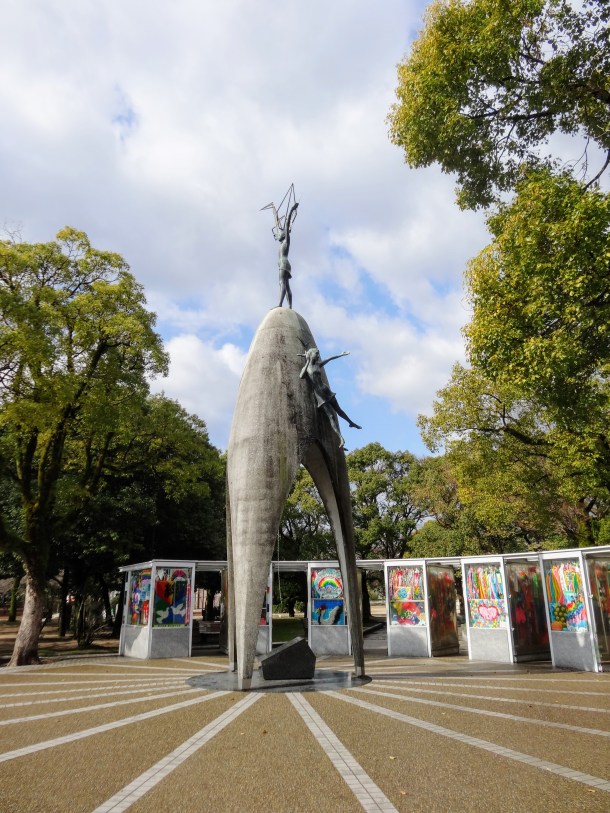
Children’s Peace Monument
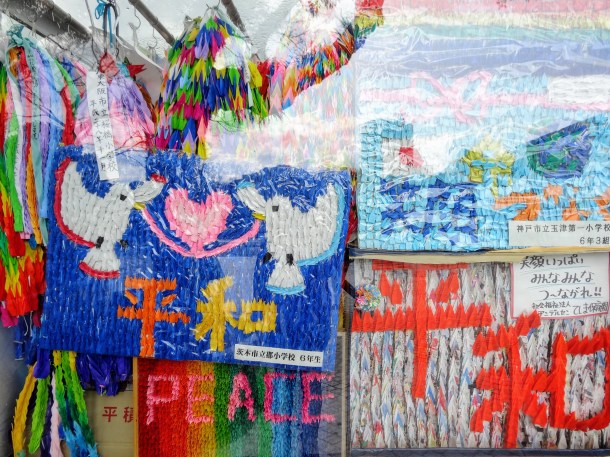
Paper crane donations
Continuing further into the park toward the museum, we walked down a long walkway, approaching the center of the park. The “Flame of Peace” burned brightly, a non-eternal flame only to be extinguished when all nuclear weapons have been eliminated from earth. In front of the fire was the “Pond of Peace,” which led to the “Cenotaph for A-bomb Victims,” a structure that held the names of all of the Japanese people who died from the blast. Looking through the archway above the cenotaph, it perfectly framed the Pond of Peace leading to the Flame of Peace, with the A-bomb Dome in the background— a powerful message calling for eternal world peace. Flowers stood in front of the cenotaph, and I saw a shaken man praying there. I’m sure people living here had relatives who died from the blast, or relatives that developed diseases or warped body parts as a result of the radiation. The bomb’s effects on families here are still very tangible.
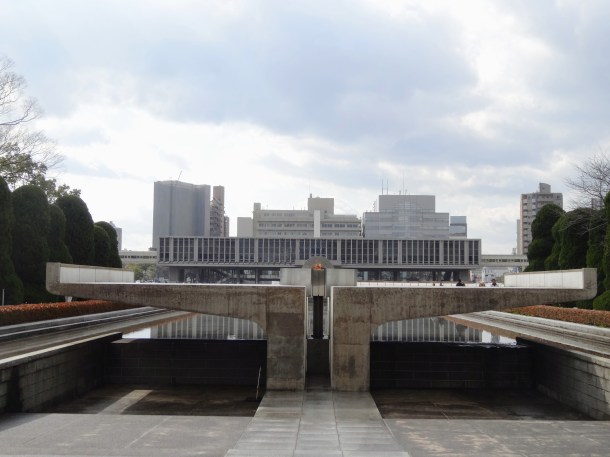
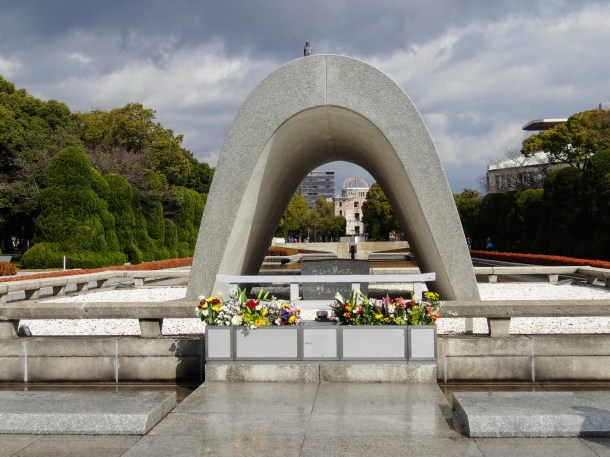
Also on the grounds of the Peace Memorial Park was the Peace Memorial Museum. I was glad I picked up the audio guide, which added extremely moving accounts of people in Hiroshima in 1945 and really brought the featured artifacts to life with touching stories. The museum started with pictures taken of the mushroom cloud, and the only photo taken of survivors on the day of the blast. The man who took it said he walked around the city for three hours, but couldn’t bear to take any more photos. After walking down a hallway lined with rubble and disorderly bricks, you reach a room that had a scale model of the city with a large red ball hanging over it— a scale model of the fireball that descended on it. It also shows a model of the A-bomb, and several artifacts like children’s burned clothing and school bags. Immediately after turning the corner in this room, you see models of people, badly burned and with skin literally hanging off of their bones. The bomb’s heat reached 3,000 degrees Celsius, and these were the real effects of that heat. The audio tour explained some of the stories behind the objects. One particularly moving one explained a lunchbox, completely charred inside. The child’s mother had packed his favorite meal for lunch that day, and he was really looking forward to eating the soybeans his mom had packed. He never got to eat his lunch. Another moving story explained that a mother was only able to recognize her daughter by the shoes she had on. Her mother made them for her out of the cloth of an old kimono. Her body was too badly disfigured to recognize otherwise. A rusted tricycle, his favorite toy, was buried with a boy who died from the blast. Another boy who returned to his town and the news of his younger brother’s death saw a block of glass bottles melted together from the heat of the explosion. He mumbled, “It must have been really hot.” The museum path moved on to feature roof tiles that had been partially melted, then dried again, creating a bumpy surface on tiles that should have been smooth. It also showed support beams of bridges that had been bent and misshapen. A book recording the aftermath of the tragedy listed causes of death as smashed head, burned alive, crushed under a building, and also commonly noted: no one to pick up the remains. Families looked for notes written on walls, chalkboards, and ceilings to tell them anything about the whereabouts of their loved ones. Hospitals were overwhelmed with the amount of people coming in and couldn’t give proper care to the victims. Some were treated with cooking oil. Many died within days of the impact, while others developed deformities and diseases from the radiation. No one knew what to prepare for since the effects of an atomic bomb on the human body had never been seen before. One man’s fingernails grew in long and black after the bomb. Others developed purple spots on their tongue and skin. Others developed cancer. The bomb devastated the city and the people for years afterward, and still to this day.
At the end of the museum route there were videos of survivors giving their first-hand account of the day and afterward. There were also photo books of politicians who had visited from all over the world and wrote messages recognizing the horrific consequence of nuclear weapons. Although the museum was overwhelming, it was extremely moving and made me think about the gravity of nuclear weapons, as well as the role of the U.S. in international affairs. I hope the world never sees another day where the use of atomic bomb is necessary.
Following the museum, we got lunch near the port servicing ferries to Miyajima. We both ordered soba noodles with grated yam in a steamy broth. Then we boarded the 10-minute ferry to the island of Miyajima, famous for the Itsukushima Shrine’s floating torii gate. We could see the large, looming red gate as we approached the island, the Seto Inland Sea lapping against its wooden beams.
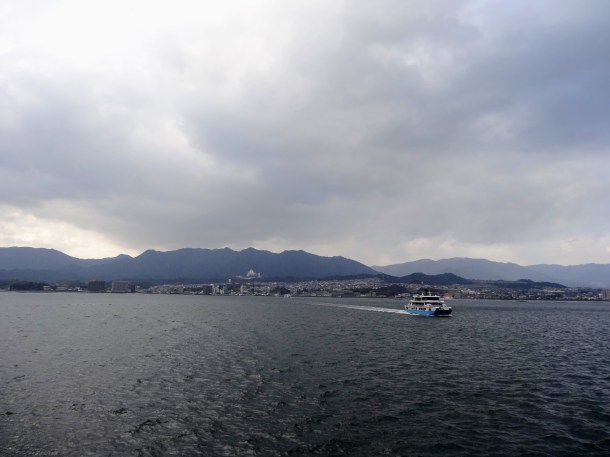
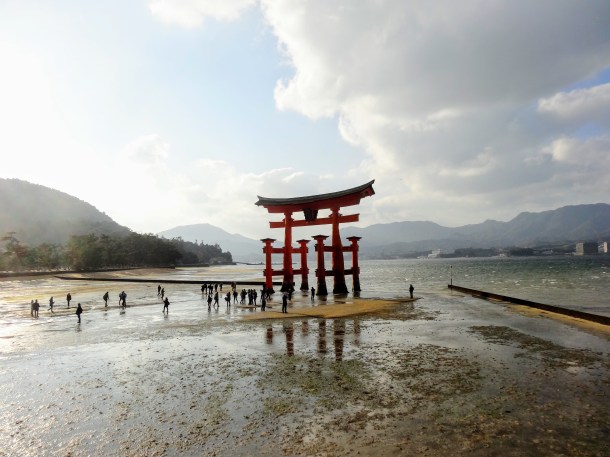
We reached the island, and walked toward the central part of the town. We walked through Senjokaku (aka the Toyokuni Shrine aka the Hall of One Thousand Tatami Mats), which was adjacent to a 5-story pagoda. The entire inside was made of heavy wood— large wood columns supported the roof, and we wore slippers on the wooden floor. The sides were open-air, and there were paintings adorning the support beams near the ceiling.

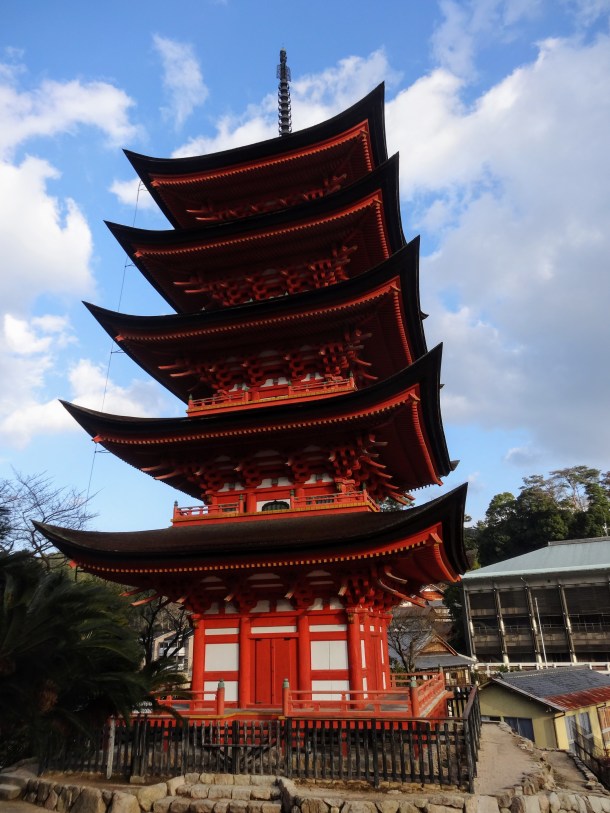
Inside the temple, we met a German girl who had just finished high school and was traveling some before she planned to study architecture in Berlin. She was traveling alone, so we invited her to join us as we meandered around the island without a plan, and she happily accepted. Since most of the shops and restaurants had already closed due to it being the slow season and some iffy weather, we decided to checkout the park nearby. Deer ran through the forest flanking the walking path, and it was neat to see them so close, yet still in their natural habitat. We walked through the park, talking along the way.

It was starting to get dark, so we left that area and headed back toward the port where we said bye to our German travel companion. The main reason we had come to the island was to see the torii gate lit up at night, which we heard was one of the most scenic sites in Japan and worth staying for. So as we waited for it to get dark enough, we stopped in a dessert shop selling maple-leaf shaped desserts filled with chocolate, pumpkin, cheese, cream, green tea… the list goes on and on. The maple-leaf dessert, called Momiji Manju, is supposedly iconic for the Hiroshima area. Not only was it advertised everywhere, it was also recommended in several reviews, so we ate a few. My favorite was chocolate, as you might expect.
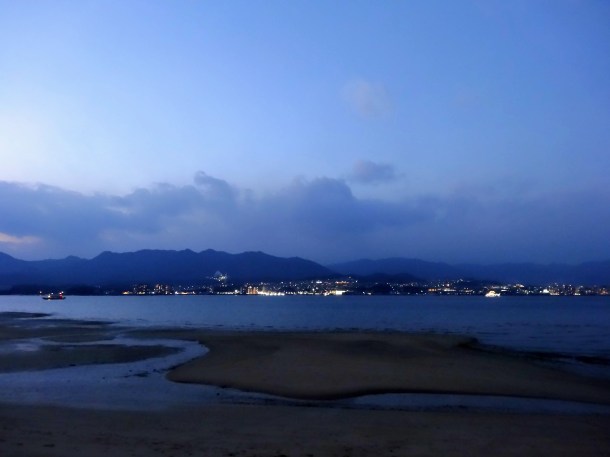
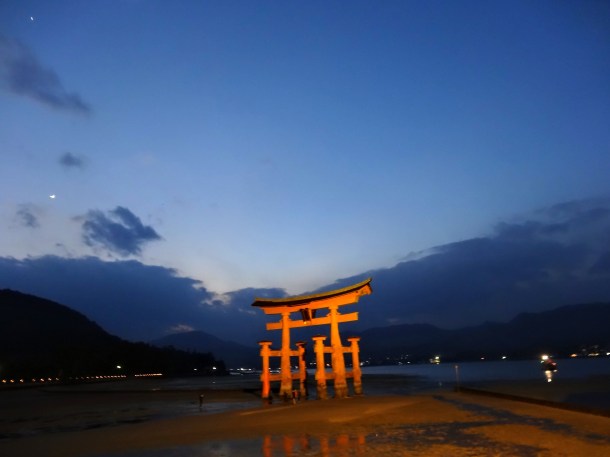
Then we headed to the torii gate, illuminated by spotlights against the dark sea. The clouds were arranged in a painting-like expanse, creating a beautiful view. The sun hadn’t fully set yet, so a gradient royal blue filled the sky, punctuated by gold-rimmed clouds. The colorful sky contrasted against the giant, red pillars of the torii gate standing boldly on the beach— it was a scene we were glad we stayed for.


Finally, we took the ferry back, and agreed on a change of pace from Japanese food. We went to a good, albeit overpriced, Indian restaurant. Then we headed back to the hotel, ready to go to Osaka the next morning.
 Mandarin Allison