Since we arrived slightly later than planned, we went straight to the women’s association for our cooking class, luggage in hand. We met a very kind French couple, who enjoyed making a couple friendly jabs at our nationality. The four of us put on our aprons, and were instructed by a Japanese guide in English on how to make miso soup, a big sushi roll, and a spinach salad with sesame dressing. To make the broth for the soup, we needed to soak seaweed for 30 minutes to an hour in warm water, and then put a handful of tuna flakes into the broth until they sank. Drain everything, and you have your broth. We used this broth in making the sesame dressing and egg omelettes before adding strips of seaweed, cubes of tofu, and soybean paste to make the miso soup. The egg omelets were cake-like and sweet, and we eventually used them inside the big sushi roll. The ingredients were sugar, cooking sake, egg, and soup broth. To cook the omelettes, we used a small, square pan, and folded a thin layer of the yolky mixture it on top of itself to form a roll, and then repeated the process once to make it bigger.
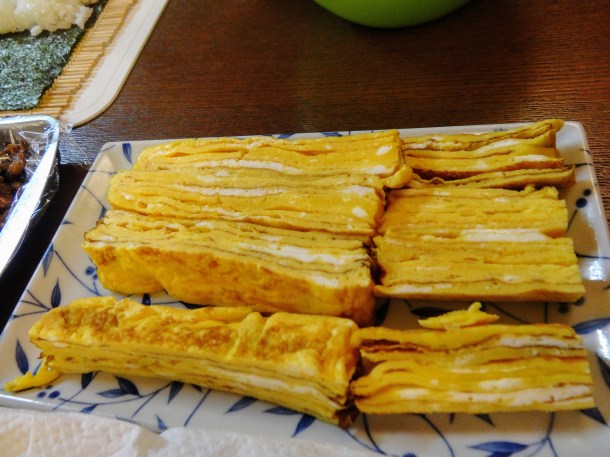
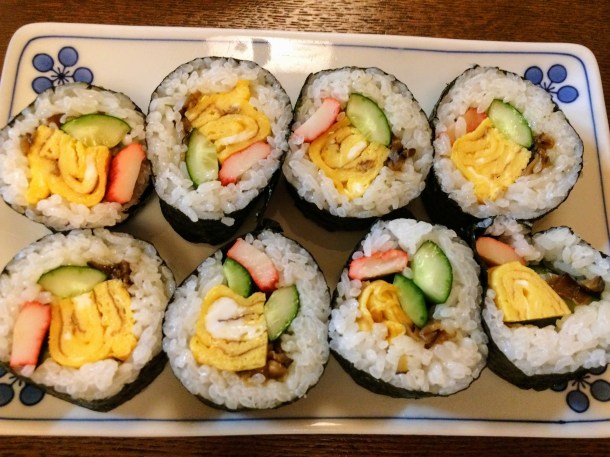
The egg omelet, imitation crab meat, cucumber, and shiitake mushrooms were what would later be the innards of our big sushi roll. We also combined a set of ingredients, including roasted sesame that we crushed ourselves with a pestle, to make the sesame dressing. We added rice vinegar to the white rice to create sushi rice, then we dipped our hands in vinegar water to spread the sushi rice evenly across the seaweed paper, leaving an inch at the top to close the roll. We used our fingers to create a small nook in the center of the rice for all of the ingredients we would layer inside. Using the bamboo mat beneath the premature sushi roll, we rolled the mat tightly and evenly, so the bottom of the seaweed was now matched up with the inch we left open at the top.
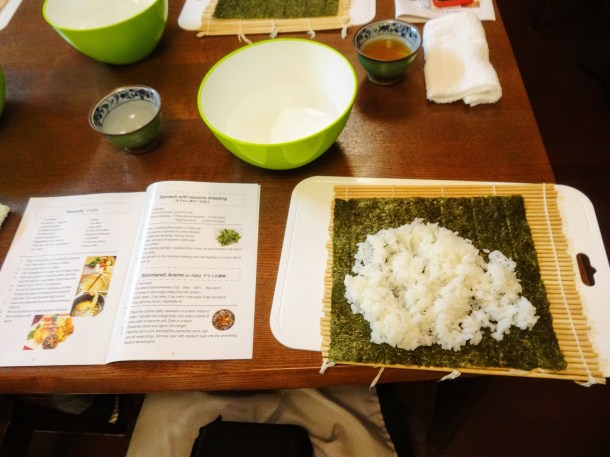
We rolled it again tightly, and ta-da, an almost complete sushi roll. From there, we cut it in half, the halves in half, and the halves in half again to create eight, colorful pieces of bulging sushi. Served with the now finished miso soup, spinach salad with sesame dressing, warm tea, and a side of wasabi and soy sauce, this was the perfect way to start our time in Kyoto. We ended the meal with vanilla ice cream topped with green tea powder. With a booklet of Japanese recipes in hand, we were off to the hotel. I’m definitely looking forward to trying out some of the offerings, like teriyaki chicken and the okonomiyaki, a Japanese pancake that we’ve been saving to try in Osaka, since we’re told they’re famous there. The teacher also left us with her business card and invited us to email her about any Japanese-cooking related questions. All of the Japanese people we’ve met have been so kind!
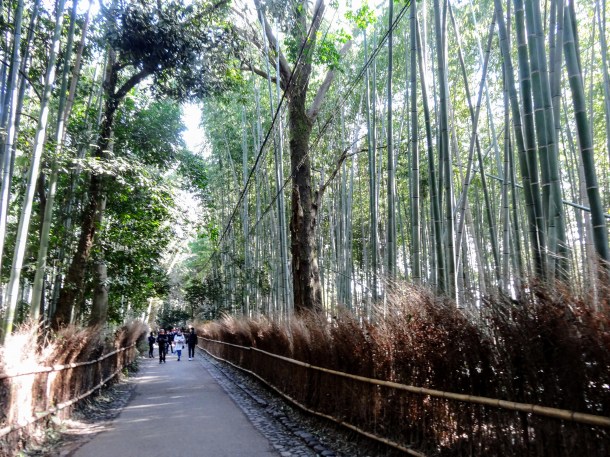
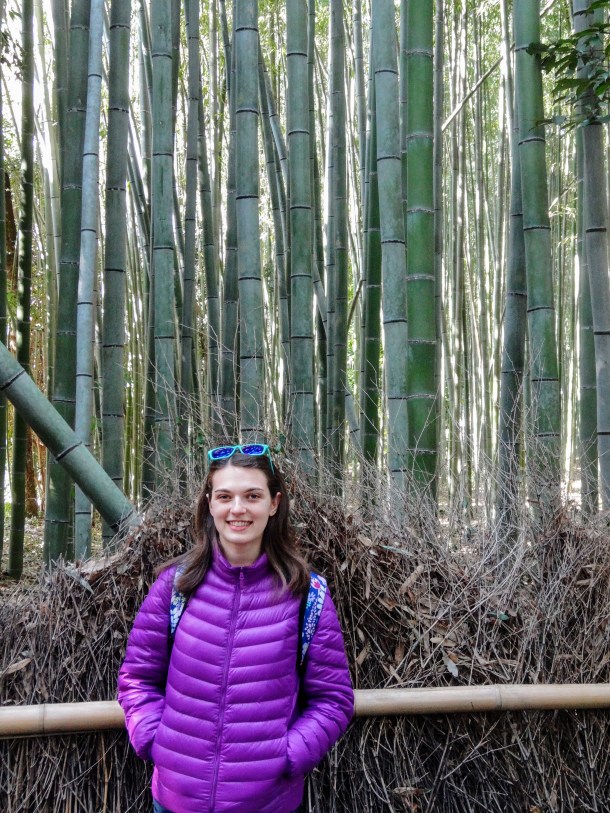
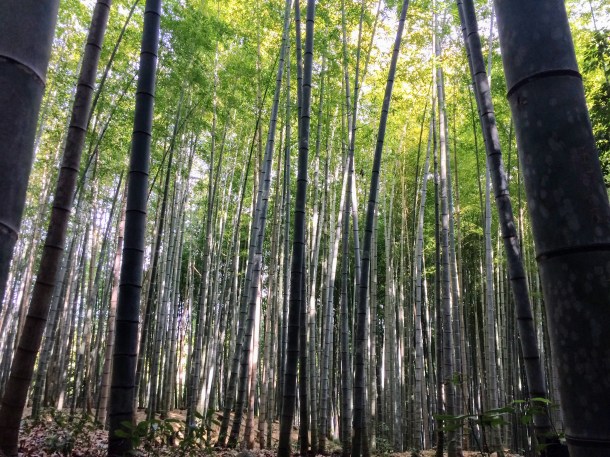
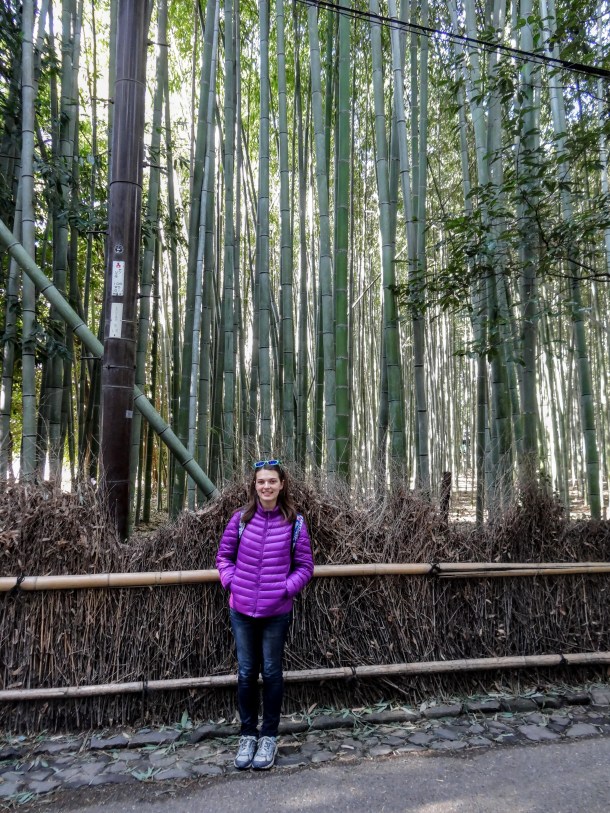
Day two of Kyoto has probably been my favorite so far on the trip. Everything we did, it seemed like the day couldn’t get any better, but the activities kept besting themselves and it made for a really solid day. We started the day by heading to Arashiyama and went straight for the bamboo grove. Towering stalks of bamboo stood with authority, flanking each side of the dark walking path. Tiny people walked through the middle of the small forest dense with solid, green stalks. The sky had vanished— we were inside Kyoto’s folded hands, protected from the outside world by the forest’s long, interlaced fingers.
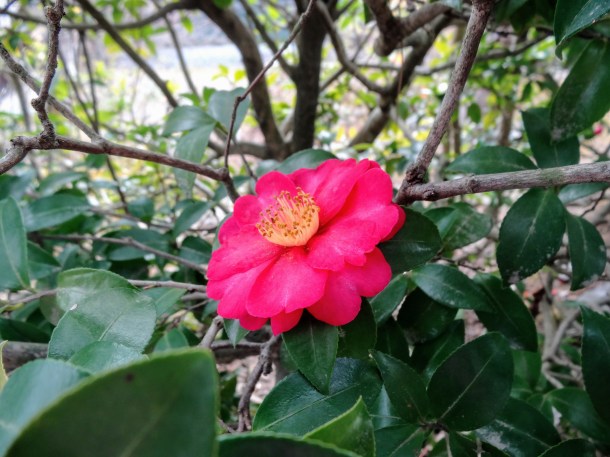
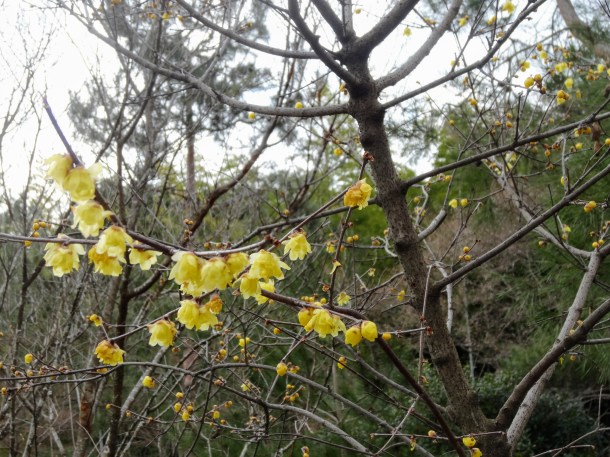
Exiting the bamboo dreamland, we headed to Tenryuji Temple, a designated UNESCO World Heritage Sight. Japan has 20 world heritage sites in total, 17 ancient buildings account for one site in Kyoto, and eight places in Nara account for one site as well, where we would go the next day. The temple was impressive, with tatami mats lining the floor. A sacred raised alcove (called a tokonoma) featured a painted scroll hanging on the wall and a vase of flowers sitting on the floor beneath. We had to take off our shoes before entering, wear slippers on the wooden floors, and remove the slippers if we were to walk on the tatami mats. Most of the rooms were open and had a few pieces of art on the walls. One room had a painting of a dragon smattered with gold leaf spanning the entire wall. While the building was impressive, what was even more so was the gardens surrounding the temple. Koi swam in carefully designed ponds. The water reflected the twisty branches of bonsai overhanging it, and certain Japanese flowers began to bloom, delicately opening in the winter air. A stone path guided people on a tour of plant diversity throughout Japan. Small bridges over streams, walking paths covered by a pagoda-style tiled roof, and lily pads resting on the water all contributed to the serenity here. The scene was close to what I had imagined based off of photos I had seen, as well as Van Gogh’s and Monet’s paintings of Japanese-style gardens. But in person— being able to sit on a bench in one of their famous paintings and take it in first hand— was truly priceless.

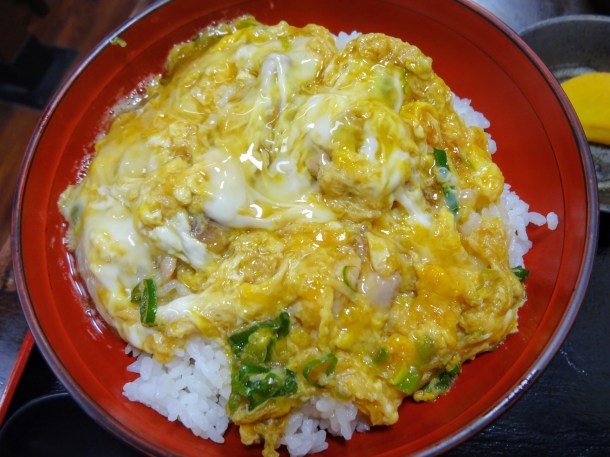
Next, we stopped for a quick lunch. I ordered a rice bowl topped with chicken, a yolky egg, and green onions. It’s nice having Japanese food on every corner.
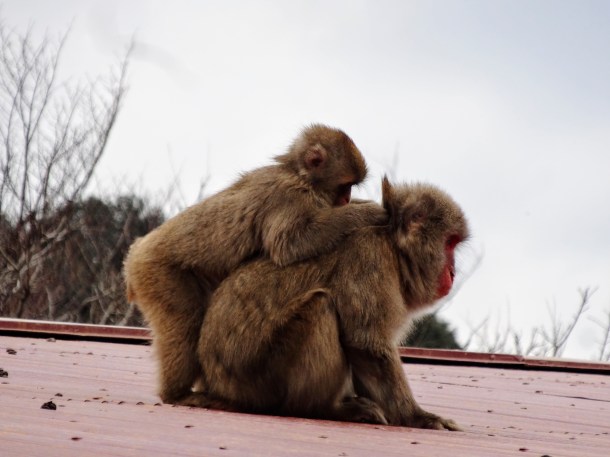
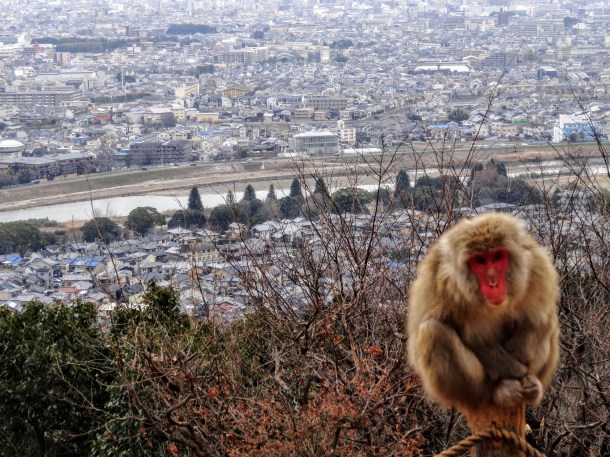
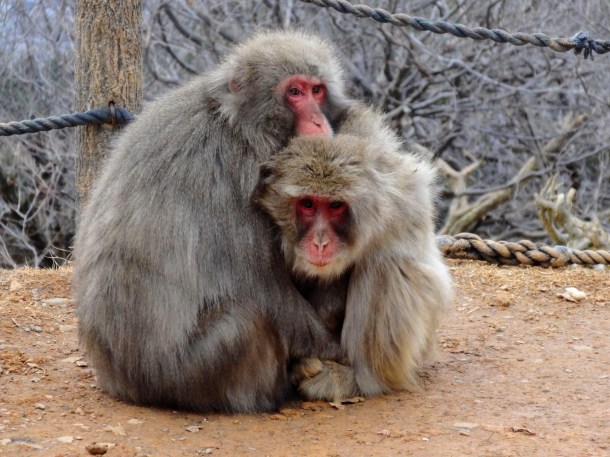
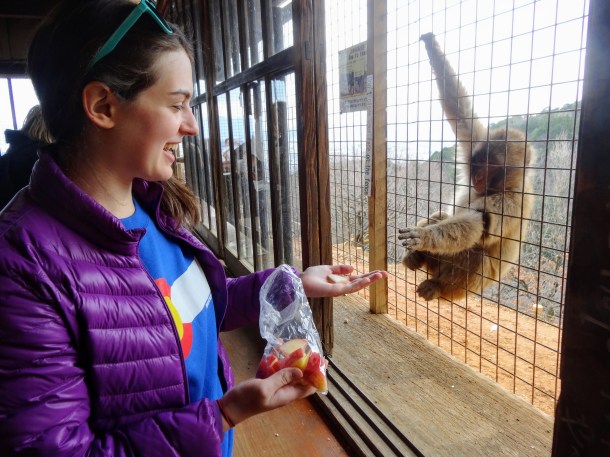
Then we headed to the Iwatayama Monkey Park. We hiked a muddy path on our way up a mountain. About 20 minutes later, we reached the top, where tons of macaques, a monkey native to Japan, surrounded a house. Inside the house, you could buy a bag of chopped-up apples or peanuts and feed the monkeys through the caged windows. It was neat to see the monkeys unrestricted, and the humans going inside the small building. This way, the monkeys could then choose if they wanted to come to the windows or not. It seemed way better than a zoo to have the animals in their natural habitat, and let them come and go from the monkey house as they please. Occasionally the monkeys would get into spats, screaming with a crazed look in their eyes and darting around until they were far enough apart that the confrontation was over. Some of the darting monkeys came close to me, which got my heart racing for a second. Thankfully, nothing happened. On the roof of the monkey house, I saw a mother and a baby picking dirt and lice off of each other’s back. And near the cliff, in front of a sprawling aerial view of the city, two monkeys, huddled in an embrace. We learned from a few “monkey quizzes” on the way up and down the mountain that the red coloring in their face and on their bottom is blood showing through their skin, and that they will sometimes eat soil and bark. We also learned that they live to be about 30 years old, and become an adult after 10 years.


It was time to leave for the city again, to return to the women’s association and meet our guide for the sake brewery tour and tasting. We had a tiny bit of time to spare so we quickly grabbed desserts at a bakery. I got a dessert with a crumbly crust, layered with raspberry jam and custard, and covered in fresh raspberries dusted with powdered sugar. I waste no time being on vacation!
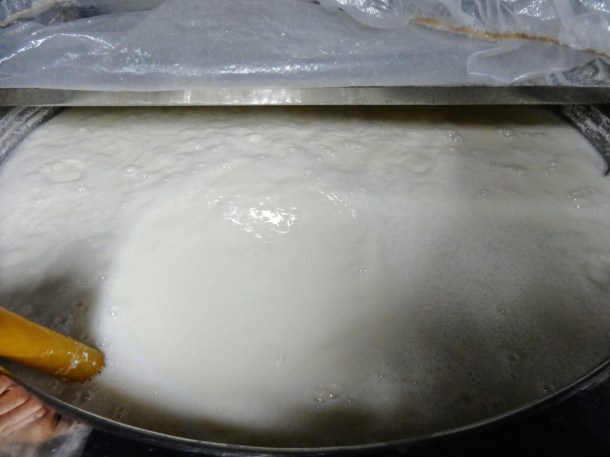
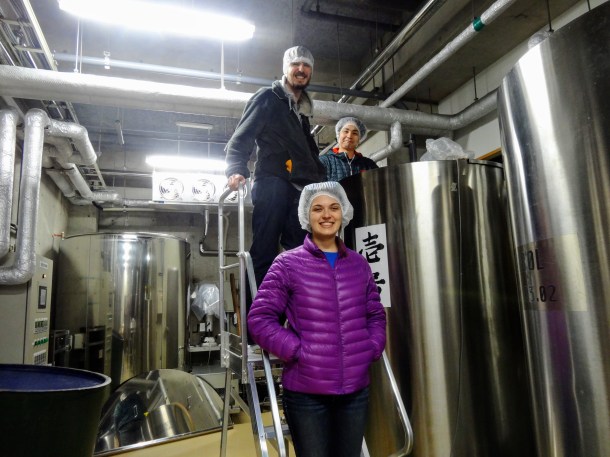
Anyway, back to the agenda. Again, our guide was extremely kind, and was waiting with a cab when we arrived. The sake brewery was in an apartment building, the location of the original brewery 15 generations earlier. At some point, it had moved locations, the building was turned into apartments, and the brew master was able to move back into the original place his ancestor had started brewing long before. The brew master and his wife lived on the top floor, and the brewery was on the first floor. Outside, hung a large brown ball, a symbol indicating that sake is brewed here. We met the brew master, took off our shoes and exchanged them for slippers, and then walked down the aisle of giant vats brewing sake. He explained that sakes are made with rice that has been polished (removing the outer casing of the rice, leaving just the starches) at different percentages, and that gives the alcohol varying levels of purity. The more polished the rice, the more pure the sake. Then the rice is combined with koji mold and local well water, and left to ferment for 30 days. He opened one of the vats and showed us the bubbling, milky mixture. It wasn’t bubbling from heat, however. Sake is best kept cold. It was bubbling from the release of carbon dioxide. Then the rice solid is pressed out of the mixture and made into cakes, and the remaining liquid is transferred to a separate vat to either be bottled or pasteurized and bottled.
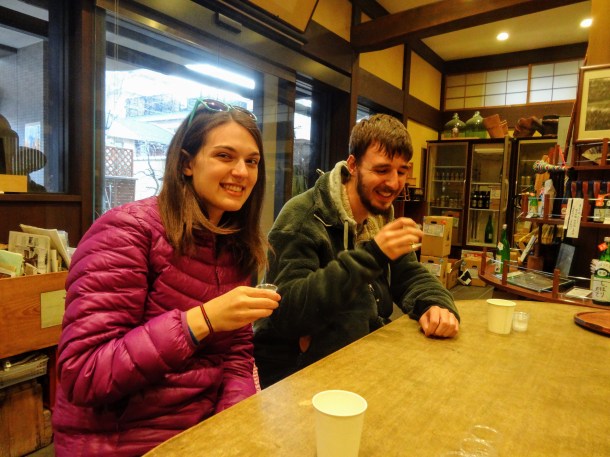
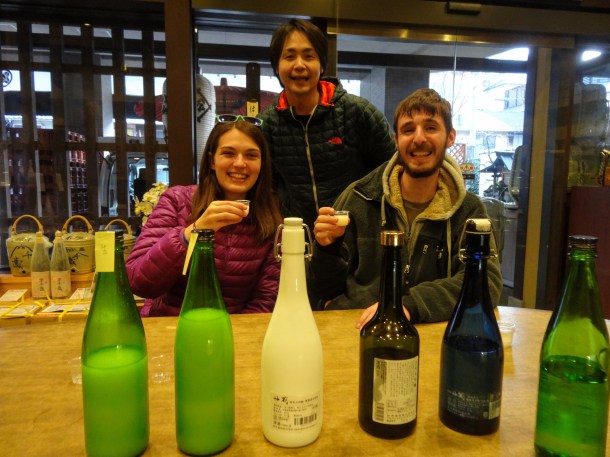
Next we sampled seven different sakes, all with between 13 and 17 percent alcohol. Although the samples were small, it was definitely enough to affect me a little. One of the sakes had flakes of gold in it and was for celebrating special occasions. The golden pavilion, a famous landmark in Kyoto was on the label of the bottle. We tried clear sake, milky sake, carbonated sake, un-carbonated sake, all kinds of sake! They were good, but strong… at least for me. It was really cool to learn about the process of making the most famous Japanese drink there is. Plus, it was great preparation for the next activity, which involved getting naked in front of a bunch of strangers.
You guessed it, the bathhouse! I’ve never been to a bathhouse before, nor ever been one of those people who walk around without clothes in the locker room of the gym, so going to the bathhouse naked was a big step for me. It was great though! I wore the gown that the hotel provided down to the separate gendered bathhouse, put it in a locker, showered off beside the hot bath at one of the stations with a seat, mirror, and soap. And then I descended into the soothing, steamy bath. The only other people in there were older Asian women, so I felt very comfortable. They’ve probably done this a million times. The whole experience was very freeing, albeit, hot. It was very much like a sauna, and after being in the water for a little while, I was sweating. It was nice to use the side showers to cool off with cold water, and then get back into the hot bath. It wasn’t too long before I felt really hot again, so I got out. The bathhouse experience was a success, and very relaxing.
Afterward, Brian and I went to a sushi conveyor belt restaurant and went a little crazy grabbing sushi off the moving platform. I think I grabbed four dishes at a time at one point. It looked too good to resist! Shrimp tempura sushi, broiled eel sushi, blowfish sushi… all an arm’s length away. Little signs designated what each fish was, and after not too long, we both had a tall stack of empty plates. I recently discovered ponzu sauce as a substitute to soy sauce. It’s similar, but citrus based, and I find it to be a little spicier. I’m a big fan. I’ve started using that if they have it. We left wanting to eat more, but stopping ourselves— another delicious meal under our belts in Japan. The conveyor belt was particularly great because you can see what food you’re getting instead of attempting to order it in a different language and then being surprised when it’s delivered.

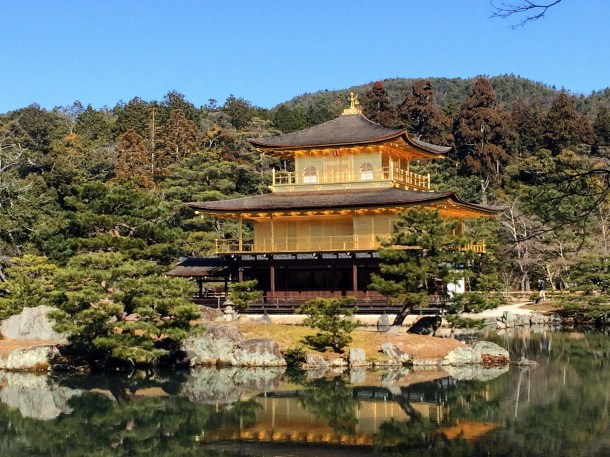
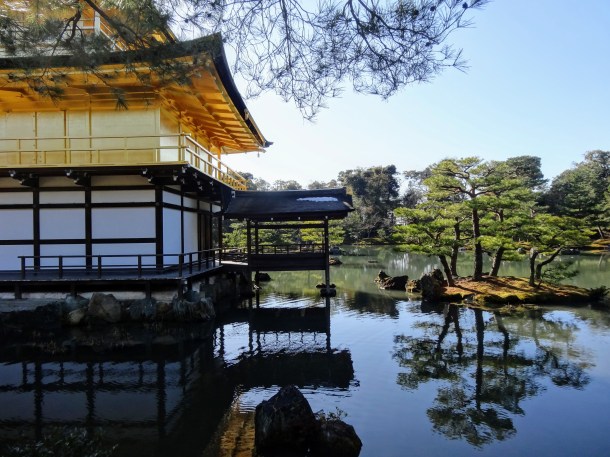
In the morning we made a quick stop to Kinkakuji Temple, or “The Golden Pavilion,” a zen, golden temple that was formerly a retirement villa for a shogun named Ashikaga Yoshimitsu. As requested in his will, it turned into a temple after his death in 1408. The interior of the top two floors are completely covered in gold leaf, and each of the three floors represent a different time period of Japanese architecture. It caught on fire several times in its history and was most recently rebuilt in 1955. The temple looked beautiful in the sunlight, its reflection glittering in the pond below it. We meandered through the surrounding gardens, and soon we had to hop on a bus to make the train for Nara.
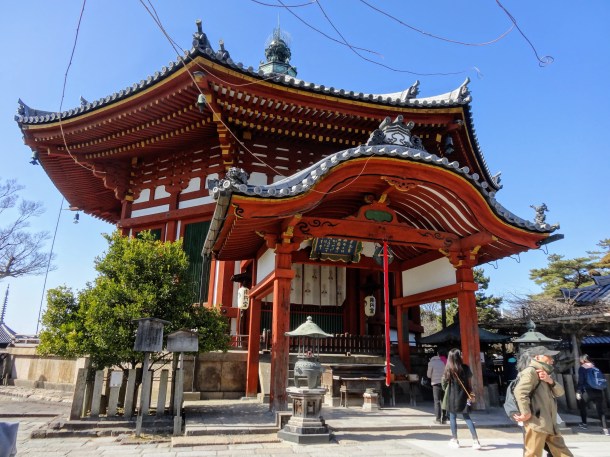
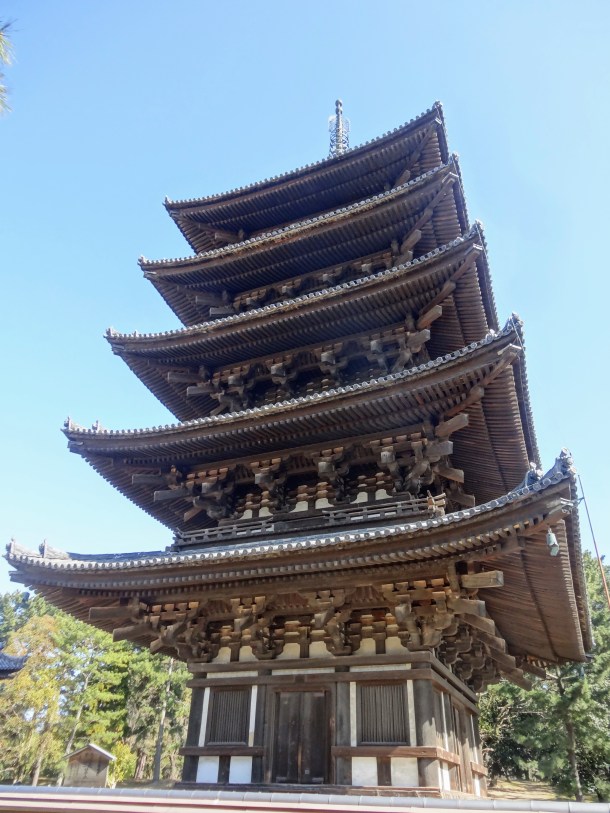
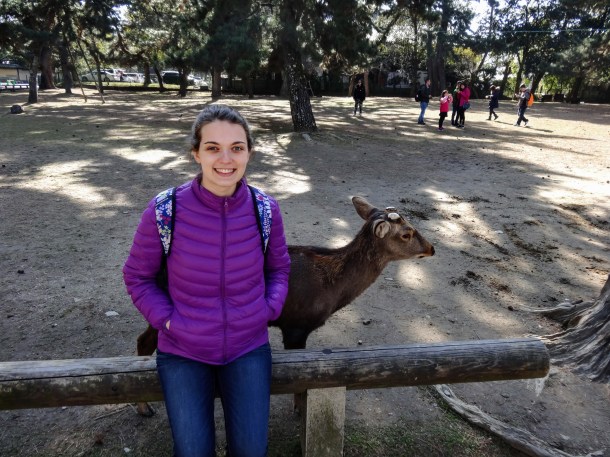
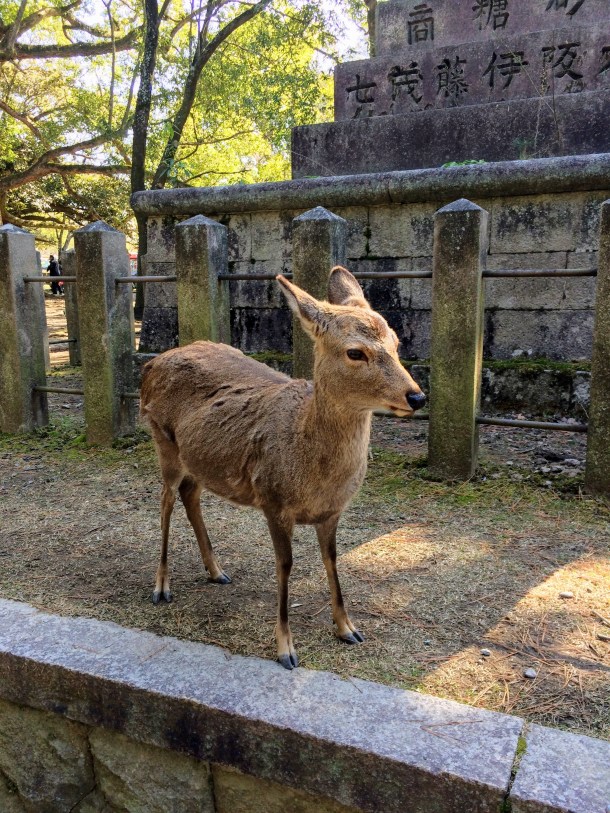
In Nara, we got our 1-day bus pass and were quickly on our way to see deer and temples. Our first stop was Kohfukuji Temple, another UNESCO World Heritage Site. We walked around the expansive grounds, which included two octagonal halls, a five-story pagoda (second tallest in Japan), a three-story pagoda, an Eastern Golden Hall, and a Central Golden Hall (which was under construction). It’s been burned down five times, and was most recently rebuilt in 1426. Did I mention that deer were everywhere? On our way up the path to the temple, friendly, snack-seeking deer were following tourists around. I got to pet a couple of them, but when they found out I didn’t have food, they weren’t too interested anymore. It was really funny to see kids, and even adults, interact with the deer. I saw a tourist, probably in his late 20s or early 30s, looking out over a scenic pond. A deer came up behind him and he freaked out, screaming like he just saw a ghost. Then he said sorry to us, and I couldn’t help but laugh. Another time I saw a kid feed a deer. After he fed the deer, it kept following him around, and the kid yelled and ran away. The deer continued to stalk him for food, and his parents just stood there laughing at him, it was pretty entertaining to watch.
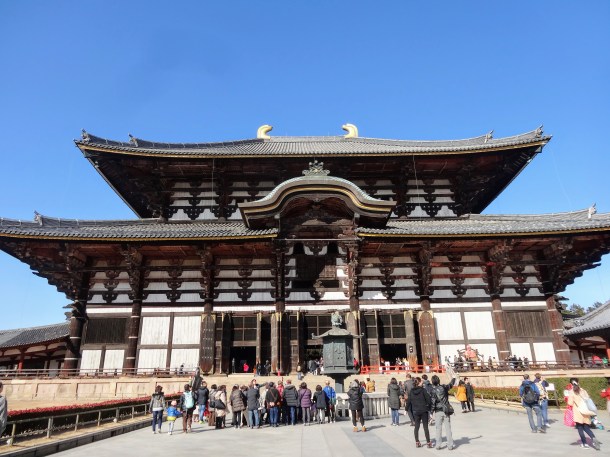
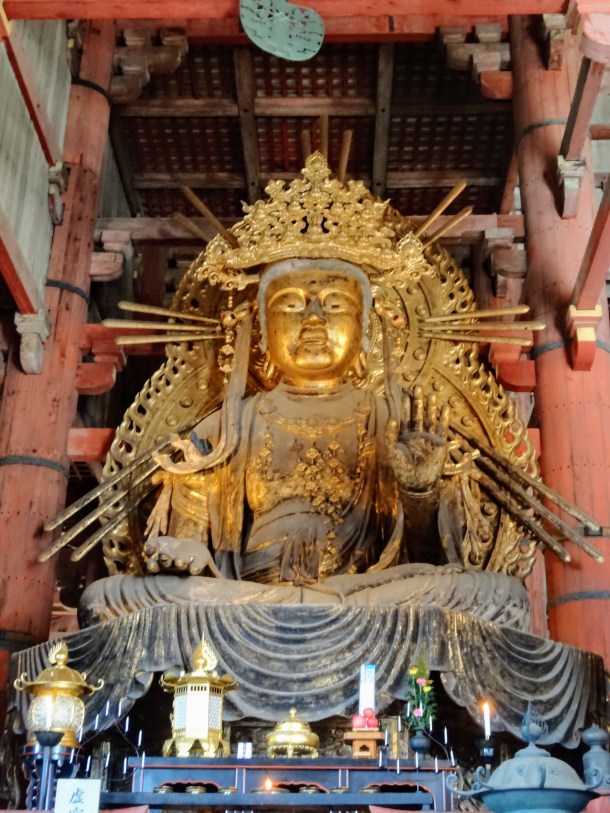
After visiting that temple, we met up with Tammy at Todaiji Temple, another UNESCO World Heritage Site. This one is known for it’s giant Buddha statue. It’s only been burned down twice! However, it was rebuilt at only two thirds the original size in 1709. Still, it’s one of the largest wooden structures in the world. The Buddha towered over tiny tourists snapping pictures. It was great to see Tammy for the first time in weeks, and she loves Japan so far. It sounds like her lab mates are very inviting, and her boss encourages her to sightsee in Japan.

We got lunch and headed to the Nara Visitor Center and Inn, where I read online that staff will teach you to make an origami deer. We arrived, and each carefully folded our paper into adorable, self-standing animals.
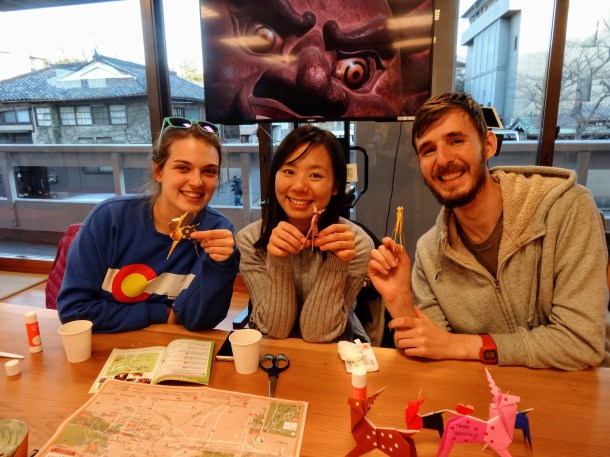
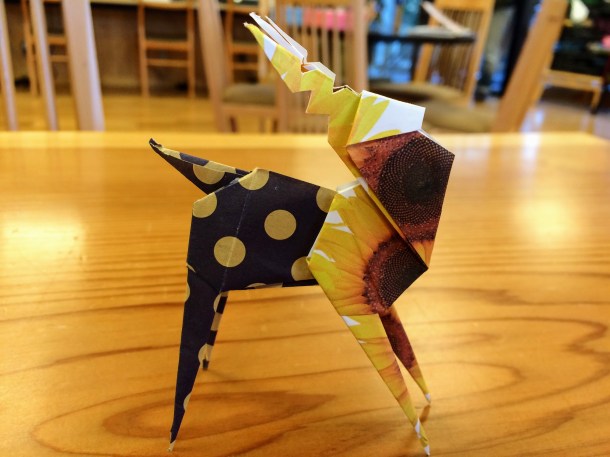
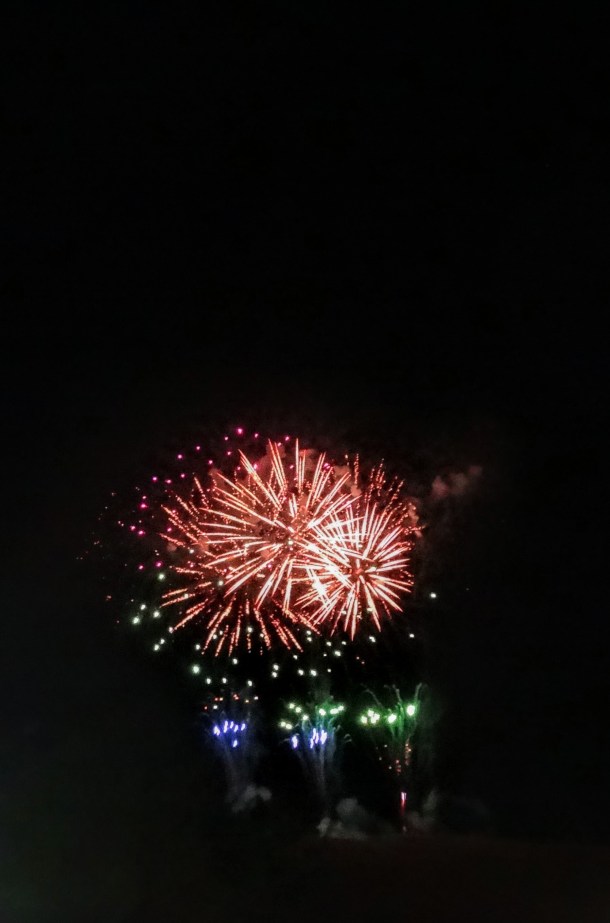
Then we got our names translated into katakana and kanji, two of the three alphabets used in Japan. Katakana is mainly for non-native words, such as iPhone or refrigerator. Kanji uses Chinese symbols to represent Japanese words. And the third type of writing system is hiragana, the phonetic alphabet. We got to practice writing our names in Japanese characters (katakana and kanji) with calligraphy brushes, which was pretty cool. Before leaving, we tried our hand in “the chopstick challenge,” where you had to transfer 20 small round beans from one bowl into another in under one minute. I bested Brian and Tammy, coming in at 15 beans, but didn’t make the official cut. The friendly staff at the visitor center told us to attend an annual festival going on that night called Wakakusa Yamayaki. A firework show lights up the sky over Mount Wakakusayama after dark, and then the grass on the hillside is lit on fire. The fire slowly takes over the grass, and soon the entire mountain is ablaze. Standing in the open field as people “oohed” and “ahed,” we watched deer-shaped fireworks burst and garner some laughs from the audience. As we walked away from the burning mountain, it felt like walking away from the apocalypse. Venus was bright in the sky that night, outshining all of the stars. We got street food on the way back to the bus stop, fried chicken for Brian and me, and a green tea flavored crepe for Tammy, and we had to say goodbye again at the train station. It was so nice we all got to spend some time together in Japan.


Finally, Brian and I walked around an area called Gion, which is known for having lots of geishas. I saw one woman with geisha-style makeup as I exited the subway, but I didn’t see any in full uniform. Apparently, the local term for geisha is “geiko,” meaning “person of the arts.” Geishas are extremely well trained party hostesses who entertain guests with conversation, games, and dance. This area also has some shopping and is known for being busy at night, so we people-watched on a popular bar and club street for a little bit, and I bought some gifts for people at a souvenir shop. Finally, back to the hotel to rest! Tomorrow, we’d be off to Hiroshima.
 Mandarin Allison