We arrived to Hakone via the “Odakyu Limited Express Romance car,” which was very roomy and surprised us with the snowy top of Mount Fuji peaking over its foothills as we approached the main station. We had the 3-day “Hakone Free Pass,” which granted us access on the local buses and entrance to most of the touristy things to do in the mountain town, but sadly, was not actually free. We rode a bus about 30 minutes to our accommodation, which was a traditional ryokan with tatami matting on the floors and communal restrooms and showers. It also featured an onsen, or a Japanese, geothermal hot spring chockfull of essential minerals that are good for your skin. Upon arriving, one of the staff members showed us around the grounds and explained the map of the area. She recommended we ride the cable car and ropeway (gondola) that day, and was extremely helpful with suggestions.
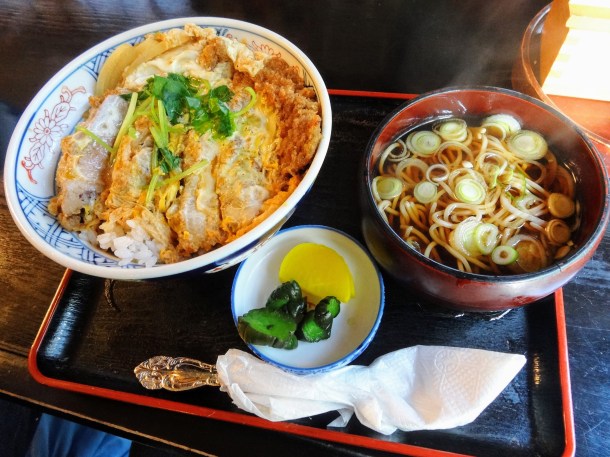
We flashed our free passes to the bus driver, and soon we were at the cable car terminal. The next one didn’t depart for a little while, so we got lunch at a nearby restaurant. I apparently can’t get enough Katsudon (fried pork cutlet and egg over rice), so I ordered it again and it came with a side of soba noodles.
We boarded the cable car and rode upwards at an angle that was essentially the hypotenuse of a right triangle. I looked out the window and pitied the tourists with hefty luggage trying to walk up the steep path. We met a guy on the cable car who was Russian and German, living in Israel, but had just finished studying in Singapore. He seemed confused about how to get around, which was confirmed when we got off and the guards told him that his pass wasn’t a free pass, and he’d have to go back. So we continued on to the ropeway, which the first half of was closed due to seismic activity/damage (unsure of which) that made it unsafe. So we took the substitute bus to the second half of the ropeway and boarded the gondola car. It provided amazing views of Mount Fuji, and no one in the car could get enough photos of the famous mountain. Since the ropeway was about to stop running, we couldn’t get off at any of the stops, but it made for a quicker return to the ryokan for the coveted wind-down routine of food and melting into the water of the hot spring.
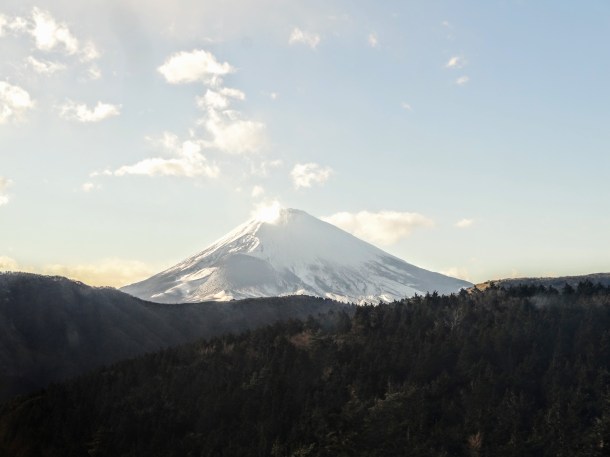
Mt. Fuji
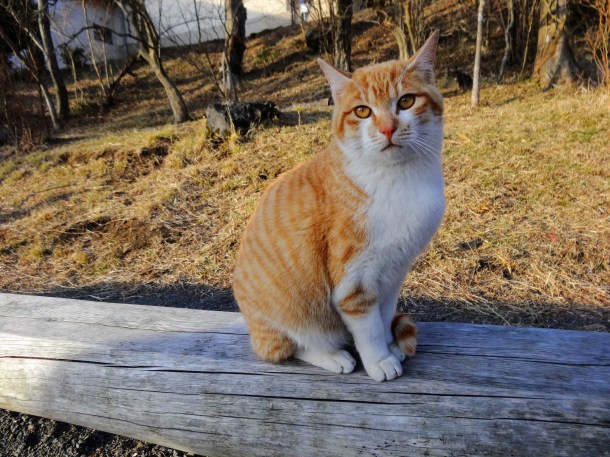
A local resident
We got off the ropeway, looked at the sun setting over picturesque Lake Ashi dotted with pirate ships, and took a bus back to the ryokan. Then we took a complimentary shuttle to a restaurant with more traditional Japanese food, and talked over hot tea in the warm restaurant, nestled on the side of a very chilly mountain. Our shuttle took us back just in time to enjoy our reservation in the onsen. We wrapped ourselves in yukata, a cotton kimono worn to and from the onsen, and then tied belts around our waists. We also wore a hanten, or a short winter coat, over the yukata.
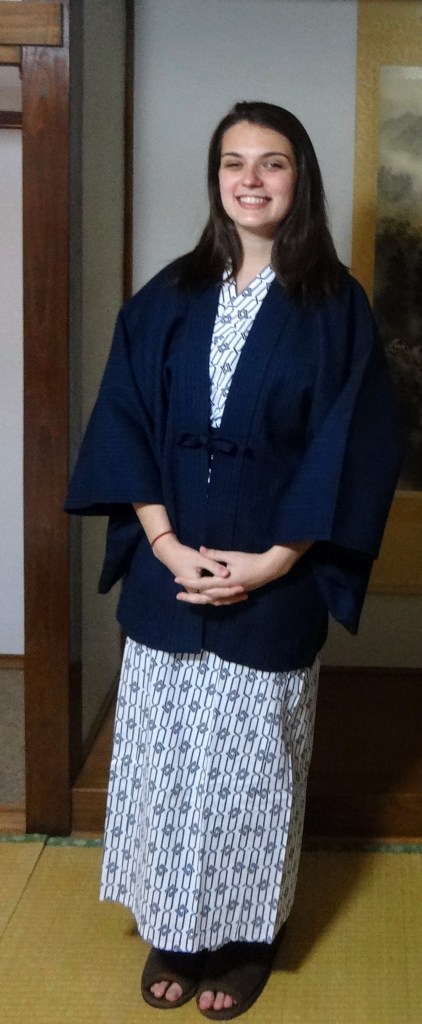
Ready for the onsen!
The freezing air (around 30 degrees Fahrenheit) quickly didn’t matter after we went into separate shower stalls to wash off before descending into the onsen. Steam coming off of the warm shower fogged up the small room and I was prepared to take on the hot spring. Putting one foot in first, then the other, my toes felt numb as they adjusted to the stark contrast in temperature. But soon, the heat became normal, and I sunk into the steamy, sulfur-smelling water. The cold air felt great against the burning bath that engulfed me. We chatted under the stars in the private onsen, and were sad when our reserved time had expired. We showered off in our separate stalls, and braved the winter air once again as we walked back into the residential building. Traditionally, onsens are supposed to be enjoyed without clothing, although, we decided to wear swimsuits. I suspect we’ll have the chance to do naked bathing in a separate gender bathhouse later in the trip.
Even washing off after the onsen AND taking a long shower didn’t completely remove the sulfur smell from my hair. What can you do? When in Japan, right?
The ryokan, while a very cool experience to see the Edo-era housing (1603–1868), was very cold! I suppose that’s historically accurate— no insulation and very drafty. Granted, we didn’t completely figure out the heater until the second night, so we were roughing it more than we had to, but wow. It really makes me appreciate the invention of the heater, and I can’t really comprehend how people handled winters before heaters existed. Even with several layers, the cold air still permeated through all of my blankets and clothing. We survived the winter night, and were on to day two in Hakone.
Our first stop was to ride the pirate ship across Lake Ashi to the other side and explore that area some more. When we arrived, another ship wasn’t departing for a while, so we got lunch at a scenic restaurant that overlooked the glittering lake. The sun shone brightly through the window, which acted like a magnifying glass, and finally we were warm! We headed back down to the boat, boarded, and took the short ride across the lake. On the other side, we walked to the Hakone Sekisho Exhibition Hall and Hakone Checkpoint, which is considered the biggest and most important of all 53 checkpoints throughout Japan. The main purpose of checkpoints was to control weapons entering Edo and screen women trying to leave Edo. Essentially, no nobleman’s wife was allowed to leave unless the Shogun knew and permitted it because all of the wives were being held as hostages. The Hakone Sekisho (the checkpoint) was settled in 1619, artifacts were found in 1983, it was excavated and restored from 1999-2001, parts were opened in 2004, and the full project was completed in 2007. Overlooking Lake Ashi, it was on a beautiful piece of land, and was nearby at least one active volcano.
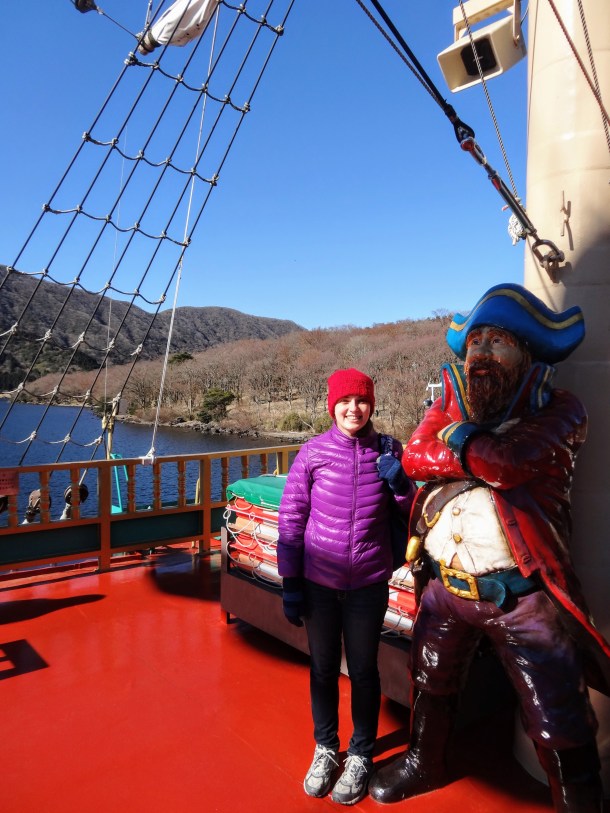
On the pirate ship

On the grounds of the Hakone Checkpoint
Next, we walked down Ancient Cedar Avenue, where towering cedar trees shaded the gravel walkway and we seemed small in comparison. These cedar trees were planted more than 400 years ago to protect travelers on Old Tokaido Road from the weather. A two-kilometer stretch of the tree-lined path remains. The wide trunks were column-like, standing grand and stoic in a perfectly straight line. Sun playfully shone through the treetops, throwing splotches of light on the ground. Every now and then we’d look left and steal glances of Mount Fuji, a constant reminder that we’re actually here in Japan, and this isn’t phantasmagoria.

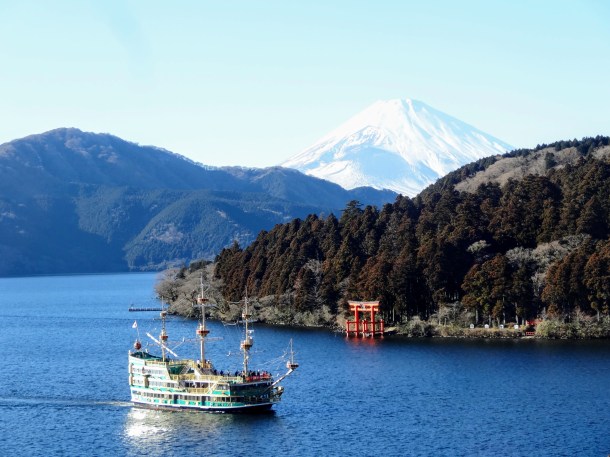
Next we meandered into the Narukawa Art Museum, which thankfully had a series of three escalators up to the entrance. The museum had a wide range of art, featuring older pieces and more modern work. One of my favorite areas of the museum was a line of ornately decorated kaleidoscopes, in which you could turn a dial or press a button and the glass beads would fold into themselves creating an ever-changing mosaic of colors against the light, some playing a delicate song reminiscent of a music box. In the room with the kaleidoscopes was a spotless window spanning the entire wall, with the perfect view of Mount Fuji— nestled behind Lake Ashi, a pirate ship approached the dock, and a red Shinto gateway stood on the right side of the water. It was an image out of Japan brochure. It’s no wonder they filled the room with comfy black chairs because I can’t imagine anyone not sitting down for a moment and taking it all in.
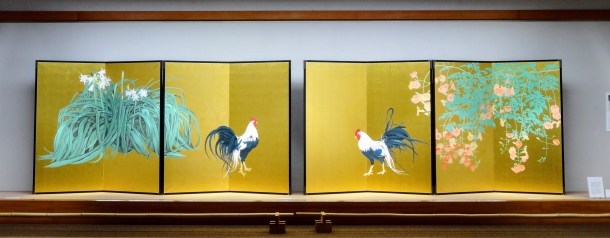
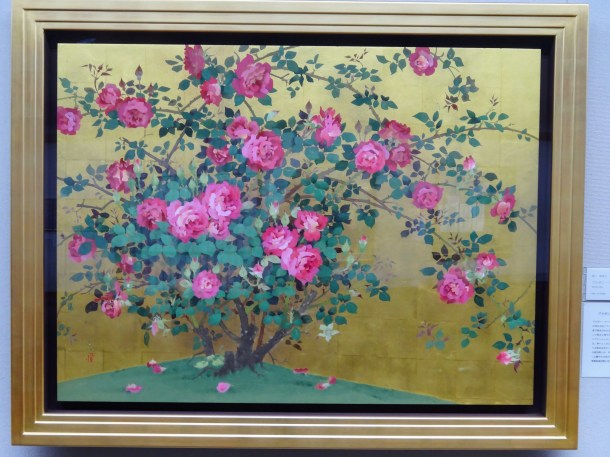
I also really appreciated the flower artwork, notably the pieces depicting cherry blossoms. The flower artwork reminded me of an ornate, painted jewelry box my parents gave me for my birthday when I was younger, and I’ve always loved the design. I had wanted to see some Japanese art while I was here and I finally got to— I noticed stylistic similarities to pieces I studied in an Asian art history class I took in college, such as the use of gold leaf, and the depiction of plants and animals. A folding screen spanning an entire room brought back memories of trips to the Freer and Sackler galleries in Washington, D.C. We also saw a huge, incredibly intricate ivory carving of daily Japanese life, which was very impressive.
Afterward, we took a bus to the Amazake-chaya Tea House, where friendly hosts invited us to sit down, enjoy some hot tea, and eat handmade mochi. We each got a taster plate of three flavors, soy sauce (savory), black sesame, and matcha (green tea). The soy sauce one had been slightly grilled and was wrapped in seaweed, and both of the others were piled with powder, making little mountains on top of the sticky dessert. I also ordered a red, fruity drink that claimed to make you less tired, which I feel like I could use on a daily basis. The sour drink was reminiscent of cranberries and blackberries, although I think it comes from something entirely different. Brian got Amazake, a sweet drink made from rice that was served with salty pickles to bring out the sweetness in the drink. It was apparently popular as a sports drink in the samurai era.
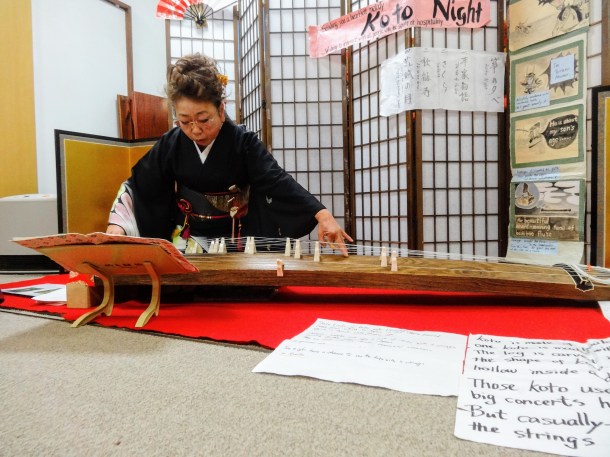
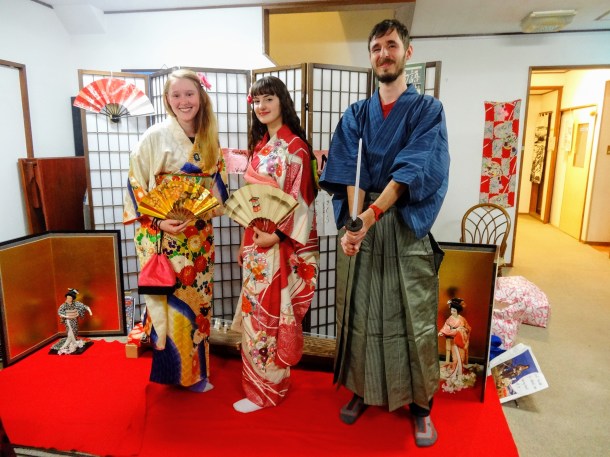
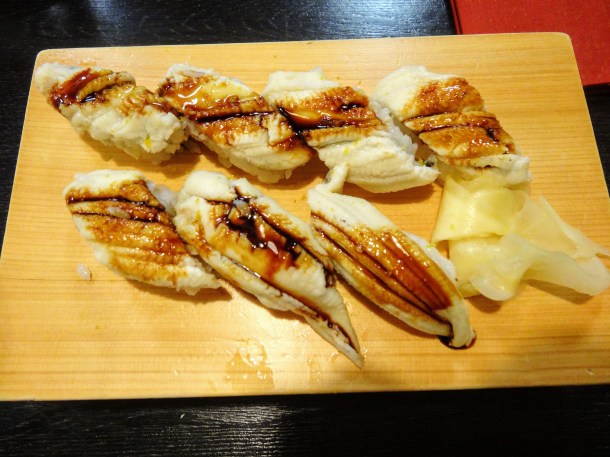
Then we headed back to the ryokan to see a koto performance. A koto is a long, hollow wooden string instrument. A woman wearing a kimono brought her grandmother along and sang in Japanese, occasionally asking her grandmother to join along. A helpful aide explained some of the Japanese lyrics and had handouts with some of the translations. Many of the songs were about the changing seasons, the moon, and Japanese folklore. Some of the audience tried on kimonos, and Brian got to try on a samurai outfit. We headed out to sushi afterward, where I ordered eel and Brian got a tuna bowl. You can’t get enough sushi in Japan… you just can’t.
The cold walk back required another relaxing trip to the onsen, steam rising off of the inviting bath. I slept better that night because we figured out the heater, although it was still cold.
In the morning, we just missed the express train to Kyoto due to some missteps in estimating how long it would take to get to Odawara station, but luckily there was an all-stops train shortly after that only added an hour to the trip and got us to Kyoto in time for our sushi-making lesson. Passing bullet trains whizzed by in an instant, a rush of air hitting you on the platform. On the train, we passed snow-covered landscapes until finally, we arrived in Kyoto, the former capital of Japan.
 Mandarin Allison