The classic airport saga: my flight from Taipei was delayed; Brian’s flight from Seoul was delayed. Delays, delays, delays.
But alas, we both made it to Narita Airport, if slightly later than we hoped. I arrived earlier than Brian so I immediately jumped at the chance to have some Japanese food, even at the airport.
Immediately after walking out the customs exit I was met by a Japanese TV host, English translator, and camera man. They wanted to interview me about my stay in Japan (how long would I be there, where was I going, where I was from, etc.) So I did the interview, walking away feeling a little sympathetic— as a former member of the media who selectively listened for quotable material, I know I didn’t say anything worth quoting.
I asked the translator where I could get some food (the fourth floor). I ordered a pork cutlet rice bowl, which featured a yolky egg over a juicy slab of fried pork and rice, garnished with a leafy green. Served with a tall stack of shredded cabbage and pickled veggies, I was already impressed by the deliberate combination of flavors and aesthetic presentation.

My first of many katsudon experiences
I didn’t think the trip to the bathroom would be worth noting, but oh it was. The jazzy toilet had all kinds of deluxe functions, including a spray, bidet, and a “flush noise” feature that is apparently only in women’s bathrooms, meant to mask unpleasant sounds in an attempt to be maintain privacy and femininity.
Finally I met Brian after we discovered we were in completely different terminals. We took a train and a cab to our hotel, which had another decked out toilet. This one had a heated seat! Japan seems to have some kind of fascination with toilets and making sure your experience on them is pleasant.

All toilets should have heated seats
The next morning, we met our tour guide, Ren, who was in his late 20s and grew up in Japan. He had traveled a lot and had studied some in the US, so he had lots of good stories, especially about his culture shock coming to crazy American college from private, reserved Japan.
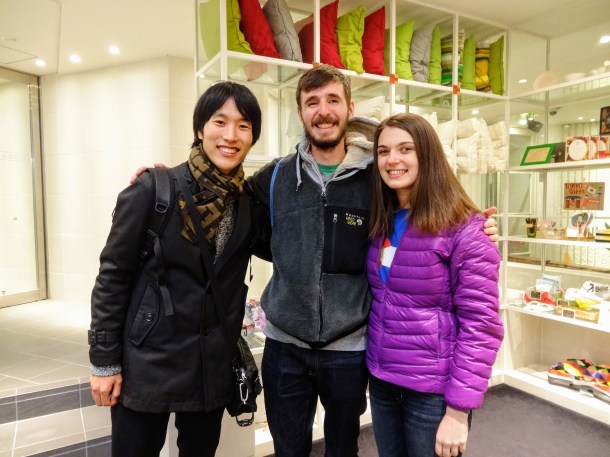
Ren, Brian, and me
We started off at the Tsukiji Fish Market, which was housed in a former train station. Men in rubber boots walked on crushed ice and carried giant, stone-eyed fish, bloodied, to go on display. Huge hunks of raw tuna, bigger than my head, sat on ice waiting to be purchased, and eventually eaten at a high-end restaurant. We saw a man stick a rod down a fish’s spinal cord, the fish giving one final lurch before it went limp. The fish sold here are that fresh— they are killed and sold on the same table.
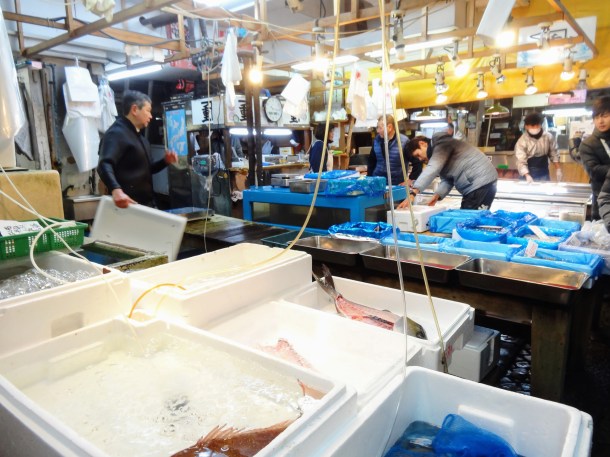
Daily operations at the Tsukiji Fish Market

The biggest fish I’ve ever seen
Everyone who touches the Tsukiji Fish Market is wealthy— the fishermen, the vendors, the purchasers. A nearby restaurant has a statue of a chubby Japanese man standing proudly outside the door. He’s deemed “the tuna billionaire,” a real man who made a fortune from selling tuna. The seafood here is the highest grade you can find, maybe anywhere. No doubt restaurants buy it for a hefty price and sell it for even more. The accountant for each stall has hand signals for what price to offer buyers depending on if they’re a regular customer or not.

The tuna billionaire
We were lucky to see the fish market, given it was supposed to have already moved locations. A government official discovered the new location was contaminated and unfit to house the raw seafood, which angered many of the vendors since they had already rented space and bought machinery there.
After the fish market, we stopped by a Shinto temple. Once you arrive at the gate, you have to bow at the waist and walk to the left to purify yourself at the fountain (pour water on your left hand, right hand, left hand again, put the water from your left hand into your mouth and spit it out). Then you walk to the front, toss a coin into a wooden slotted box, grab a thick rope attached to a bell, and shake it to let the gods know you’re there. Then, bow twice, clap twice, bow again, and wish for something. Then of course, bow again at the gate on your way out. We passed a couple grave stones for different spirits, one in the shape of an egg honoring the egg’s spirit and one honoring the spirit of sushi.
After that, we had lunch in a high-end shopping area called Ginza, and went on to see the Imperial Palace. Only the Emperor and Empress live in the palace, and it’s guarded off by a moat. The original walls of the moat are the same ones from when it was originally built. The building is only open to the public on January 2nd every year, the Emperor’s birthday. And according to Ren, it’s absolutely packed with people that day. Now Japan is on its 125th prime minister, all a direct lineage to the first prime minister— the longest governing direct lineage line the world. Prior to the royal family taking charge, the country was lead by samurai, or Japanese warriors. We also passed a monument for a particularly famous samurai named Kusunoki Masashige who died fighting for the Emperor.
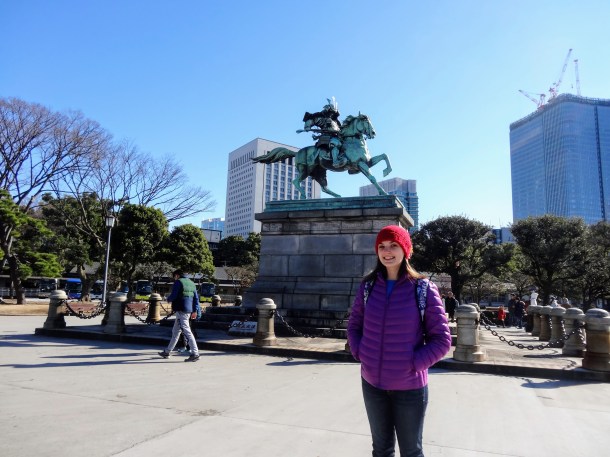
On the Tokyo tour in front of the Kusunoki Masashige monument
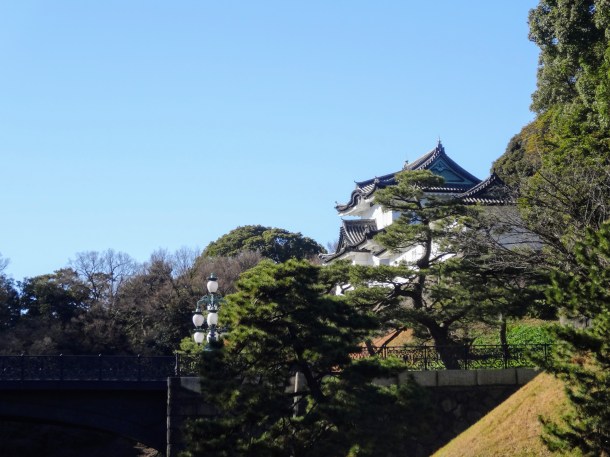
The Imperial Palace
After that, we headed toward the Meiji Shrine. Another Shinto temple, this one honored the spirit of Meiji, the great grandfather of the current prime minister who modernized Japan. As soon as he passed away, Japan built this shrine in his honor. With lots of trees shading the gravel path to the main grounds, it was scenic and peaceful. A large garden with plants from all over Japan, a pond, and a tea house was where the Empress used to come to write poetry. At the temple grounds we found wooden ornaments where people had wished for success on exams. Later they will be burned, and their smoke is thought to be a message that reaches the gods. We also saw a small parking lot where you can get your car blessed for safe traveling by leaving it near the temple and having someone perform a ritual on it. Apparently it costs around $50 USD to do.
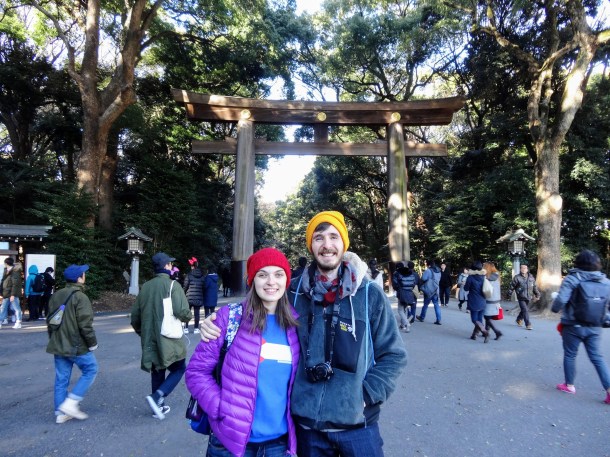
At the entrance to the Meiji Shrine
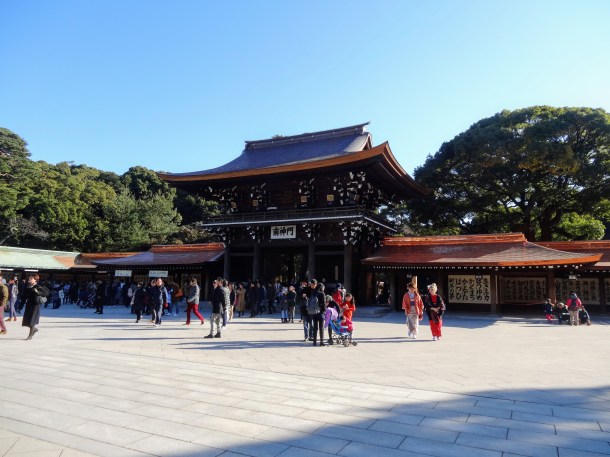
The temple grounds

People lining up to pray
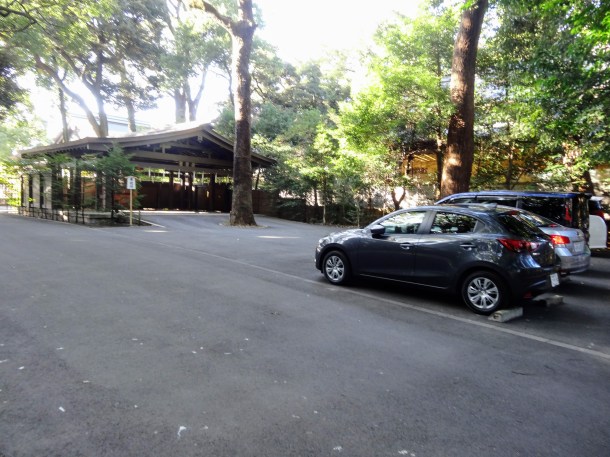
Cars getting blessed for safe traveling
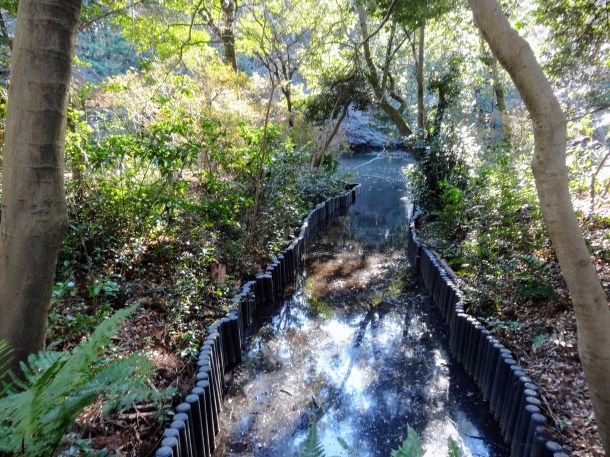
Scenic waterway inside the Meiji Shrine Inner Garden
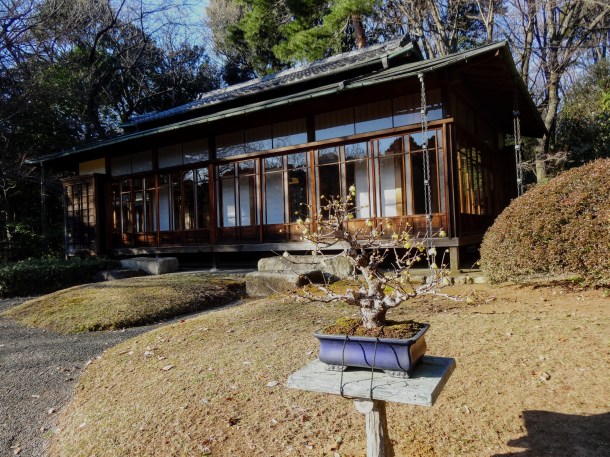
Tea house and bonsai inside the Meiji Shrine Inner Garden
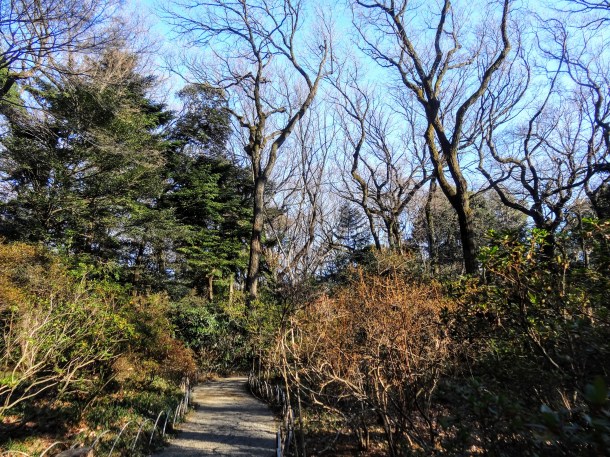
A peaceful path inside the Meiji Shrine Inner Garden

Spindly branches crisscross each other in the Meiji Shrine Inner Garden
Then we checked out the Harajuku District, which is the hub of teenage culture in Tokyo, featuring crepe stands, kawaii (cute) fashion, and photo booths with all kinds of rosy filters. It was bustling with people, bands played on the street, and I reminisced about my high school weekends spent at Westlake football games. If I were born here, my weekends would have been spent on this street, taking cutesy photos and shopping for Hello Kitty accessories. Either location, there’s no escape from being a teenager, just different environments. I’m sure there were teens I passed making memories they’ll be embarrassed about 10 years from now. I think that’s universal.
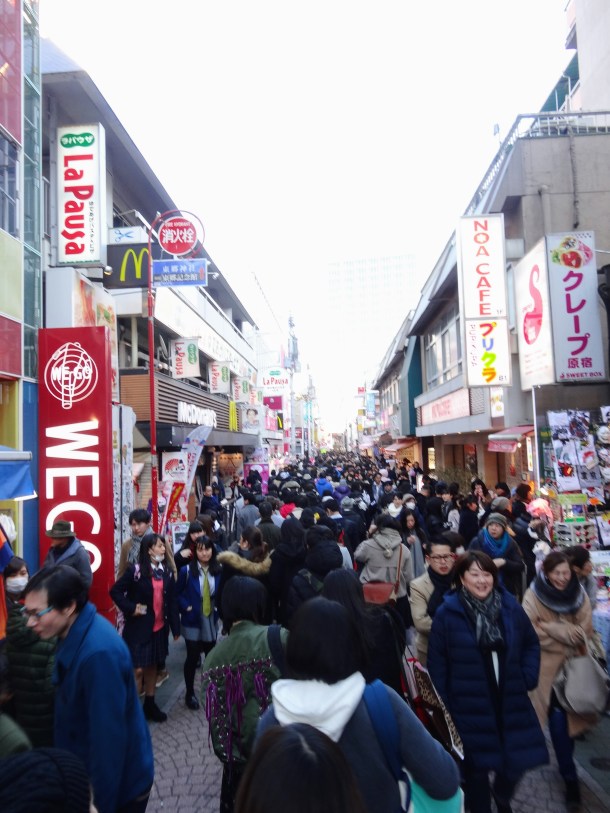
Entering the crowded Harajuku District
After a brief rest in the hotel, we met up with Brian’s friend from college, Brandon. He recommended a tempura place, where we all got a shrimp tempura tower that was meant to replicate the nearby Tokyo Skytree (Japan’s tallest tower, which is used for radio and TV broadcasting). The man delivering our food wanted us all to take photos with the shrimp tower, and take one of the small, cutout pictures of the shrimp tower sitting in a basket on our way out. The shrimp tower was obviously their claim to fame. I just learned that Tokyo Skytree is the third tallest structure in the entire world, so their gimmick may attract enough visitors to make it work.
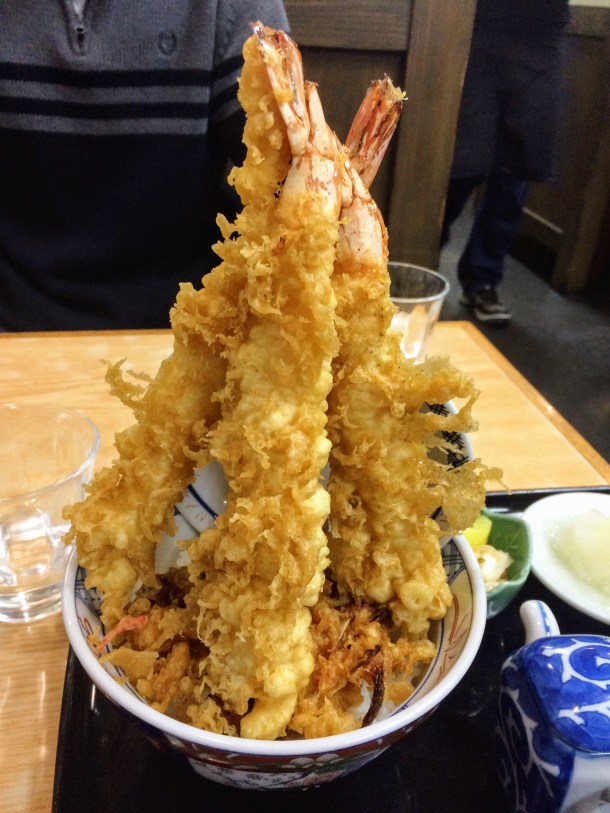
Shrimp tempura tower
Then we walked around Sensoji Temple, the oldest temple in Tokyo. It was nighttime, so the giant lanterns, impressive architecture, and threatening statues flanking the temple gate were glowing under the lights. I don’t think there’s any way a daytime visit could have outdone the stunning nighttime view. I was glad we made the short detour to come see it.
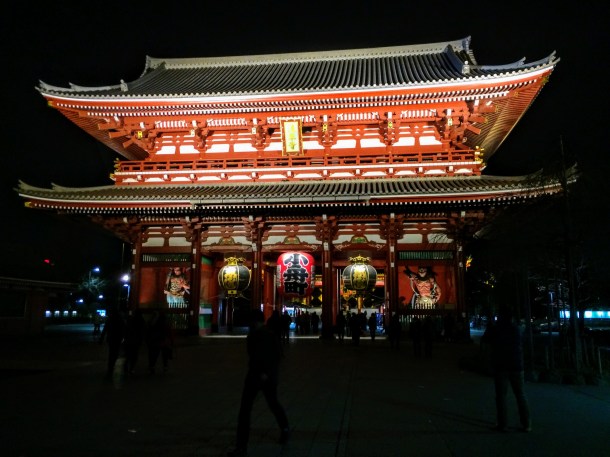
Sensoji Temple lit up at night

Piercing, yellow eyes greet you at the temple’s entrance
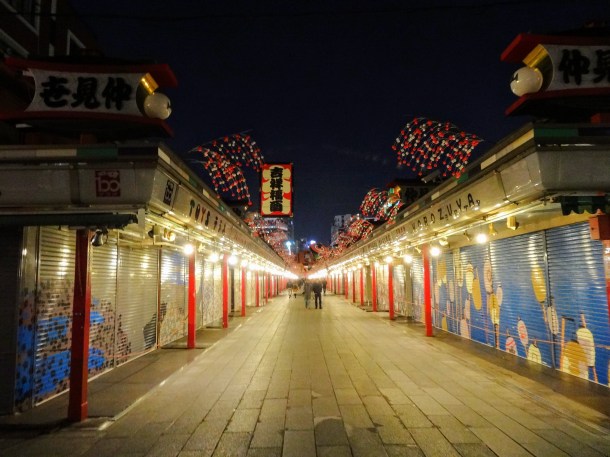
Shopping street after hours near Sensoji Temple
On the way back to the subway, we saw a tall Don Quijote building with flashing, colorful lights. Although I had never heard of it, Brian knew it was a 24-hour, all-purpose store that was well-known for having lots of random stuff, so we checked it out. It was casino-like with its bright lights, upbeat music, and escalators that only went up, further into the store. We saw everything from hotdog costumes to sausages to Hello Kitty watches. Whatever you wanted, they had it. Except for SIM cards apparently, because I’ve actually been looking for one of those.
We also passed by a batting cage/arcade on our walk back and stopped in to check it out. Supposedly these arcades are common and you can win yourself a variety of pikachu and Mario Bros. toys.
The following day we got a sushi meal at the fish market and met some cool Canadians at the restaurant. We only talked a little bit about Trump, so I’d consider it a success. Then we checked out the Hama-rikyu Gardens, which had a few things blooming despite it being winter.
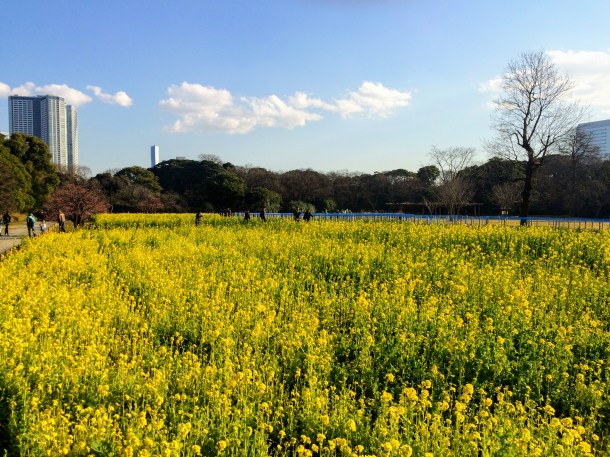
Field of yellow flowers at Hama-rikyu Gardens

Vibrant colors set a beautiful foreground for the city buildings in Tokyo

Hama-rikyu Gardens in January
Afterwards, we headed toward the Sony Showroom building. The building was designed with flower-pedal like floors that had you ascend in a slow, upward spiral, passing all kinds of iconic tech products from the past, like giant cathode ray tube TVs, boxy walkmans, and portable CD players. The first three floors were filled with old memories— floppy disks, flip phones, VCRs. It’s amazing how temporary these items— that were revolutionary at the time— have become. It makes me wonder how long it will be before we’re reminiscing about smartphones and iPads. The fourth floor was the Sony Innovation Lounge, which featured some cool, new products, like a scent dispenser, an ear piece that you can give commands to, and small sensors you could program to mix and match, fitting your needs. For instance, you could program the sound and motion sensor to pair, and place it on your door. When the door moves, a sound goes off. Or you could pair the light sensor and the motion sensor, so when you come in the room, lights turn on. There are endless combinations, which is cool because it lets the consumer brainstorm creative concepts to fit their needs, but all with the same basic tools. On the eighth floor we watched a movie in a quasi-planetarium. Stars were projected on all the walls and the ceiling, and we watched planets and auroras dance on the screen to a lively soundtrack of songs in both Japanese and English. Then we met up with Tom, my friend from high school, and his fiancé Norino for a delicious dinner of meat and veggie skewers.
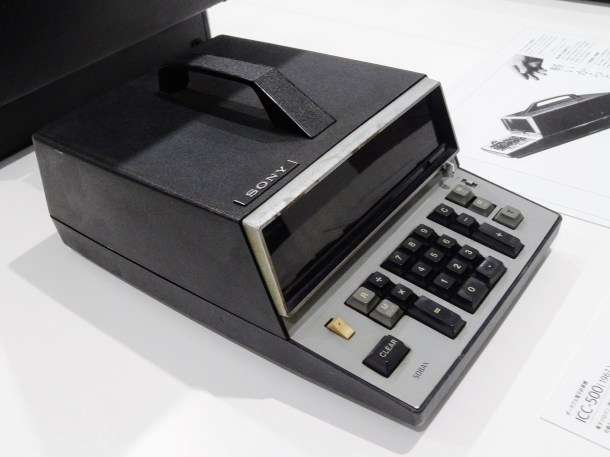
This was a calculator… it’s huge!

Some not-so-ancient Sony phones
Our last day in Tokyo was spent doing a number of fun things. We started the day off with a “Woodblock Print Party,” which sounds a little corny, but was actually really cool. Artists create a “key block,” which is the black outline of the picture, and then carve away everything that’s not black, leaving only the lines raised. Then the artist decides what colors to use in the piece, and makes one block for each color with raised areas, so when you press the paper onto the slab coated with colored ink, only those shapes get imprinted onto the paper. You can even layer the colors, so by just using red and blue ink (two blocks), you could have three colors by making the same raised shape on each slab and creating purple. We got to make our own woodblock print (just paining, not carving) of a scene from an iconic Japanese story called Peach Boy. Putting a dab of ink and a dab of glue on each wood block, spreading it around with a circular brush, lining up the corner of the paper with the corner of the woodblock, and pressing down hard with a flat, circular tool in small, circular motions was repeated four times: once for red, blue, yellow, and black. And ta da! From all the strange shapes that didn’t really look like anything, once they were all layered on top of each other, we had a completed picture! Our teacher for the day normally doesn’t run these beginner level classes, but all of his lower level employees called in sick, so we got the expert.
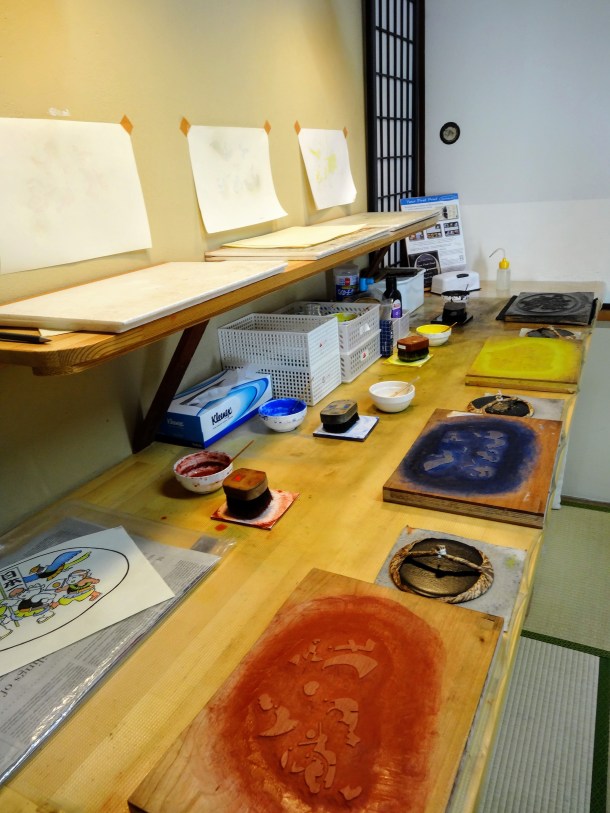
The woodblock print making setup
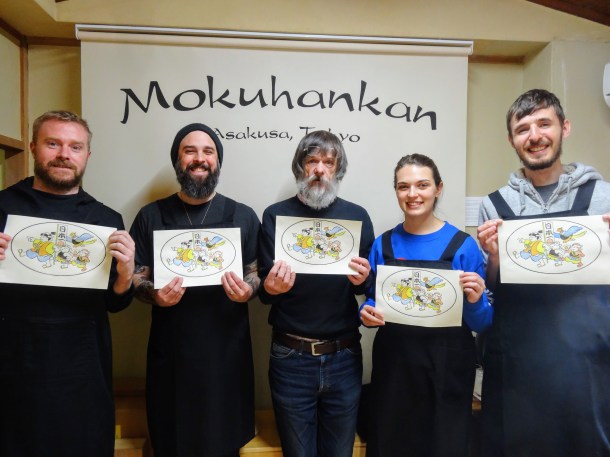
Above: The woodblock print crew! Below: Three woodblock prints made by professionals… do you notice the modern spin on the middle image? It’s the Teenage Mutant Ninja Turtles.


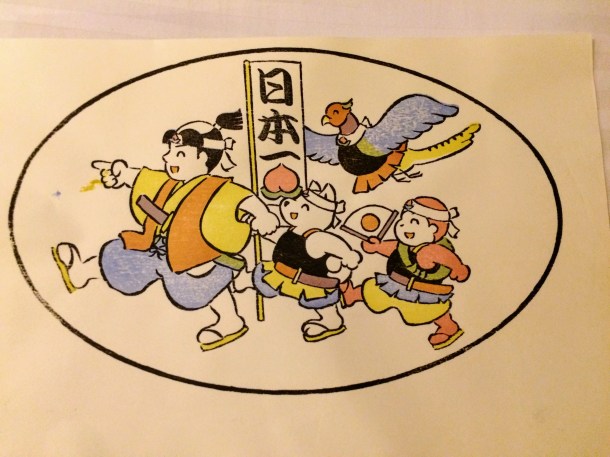
My woodblock print
Afterwards we got lunch at a fast restaurant where you pay and order via machine. We met up with Tom, Norino, and Brandon for one last meal together before we left the city the next morning. We had shabu shabu, or hot pots. We ordered two types of broth that boiled in big pots in front of us on the table. Waitresses brought unlimited slices of uncooked meat (chicken, beef, and pork) and we chose veggies from a buffet. They had a ton of different sauces, and it was fun to turn the meat with your chopsticks for a few seconds in the broth, pull it out with a few veggies, and dip the combo into each of the sauces (my favorite being the one I concocted myself of everything… soy sauce, sesame oil, garlic, ginger, pepper, chiles, radish, scallions and more).
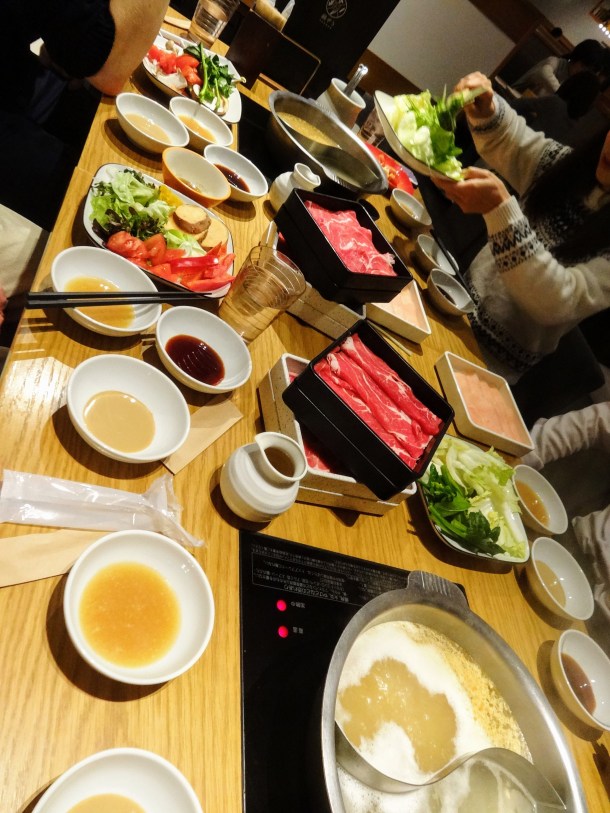
Shabu shabu feast!
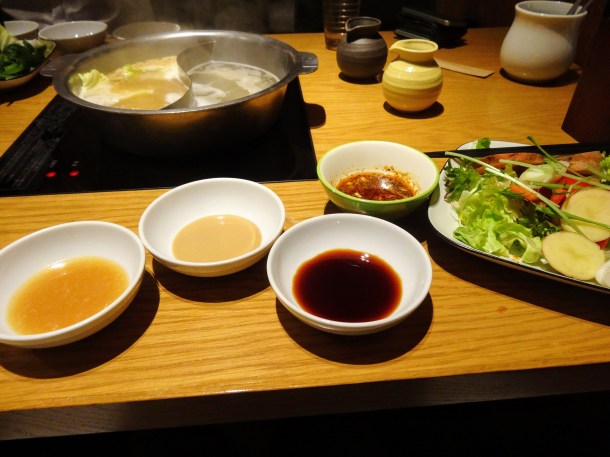
Flavorful sauces to mix and match
Post dinner, we said goodbye to our friends and checked out the iconic Shibuya Crossing, famous for being the world’s busiest pedestrian crossing. Scrambles of people crossed in all directions under neon lit signs. Finally, we walked around the Shibuya shopping area for a while, but we had to turn in because we’d have another early day tomorrow. It’s incredible how Tokyo is the most populated and the safest city on earth. It seems impossible and contradictory, but actually it tops both lists. I’ll always admire Tokyo for that. Next stop: Hakone!

Shibuya Crossing
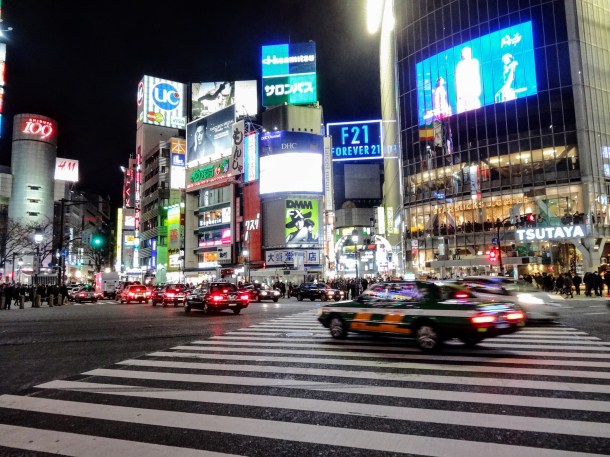
Taxis crossing the busy Shibuya shopping area
A video of the crossing in action:
 Mandarin Allison